
-
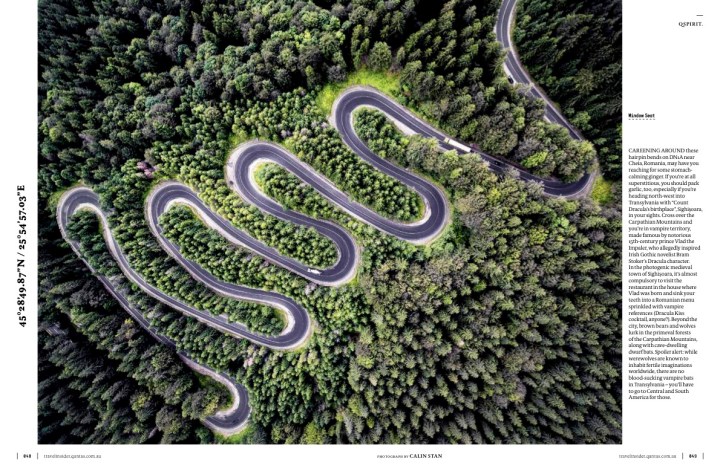
Window Seat photo prompt: Dracula’s Romania
Words by Liani Solari • Photograph by Calin Stan
Published in Qantas’s inflight magazine, November 2017
Careening around these hairpin bends may have you reaching for some stomach-calming ginger. If you’re at all superstitious, you should pack garlic, too. Read more
-
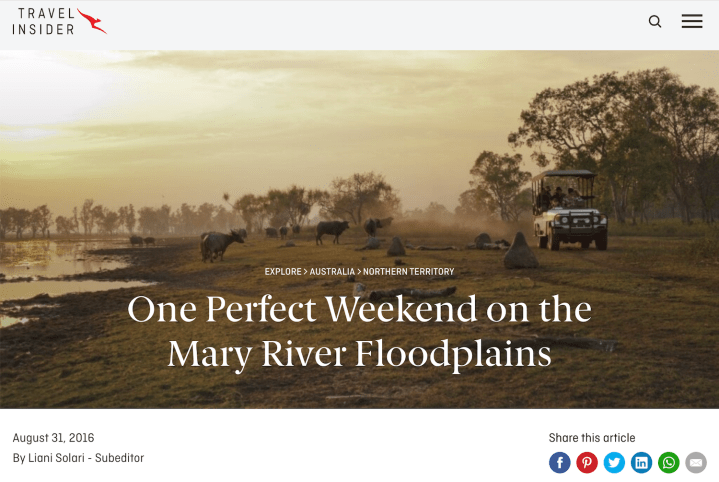
One perfect weekend on the Mary River floodplains
Words by Liani Solari
Published in Qantas’s inflight magazine and on Qantas Travel Insider, August/September 2016
Following a dry Wet Season at Bamurru Plains, lodge guests discover there’s more to the Top End than barra fishing. Read more
-
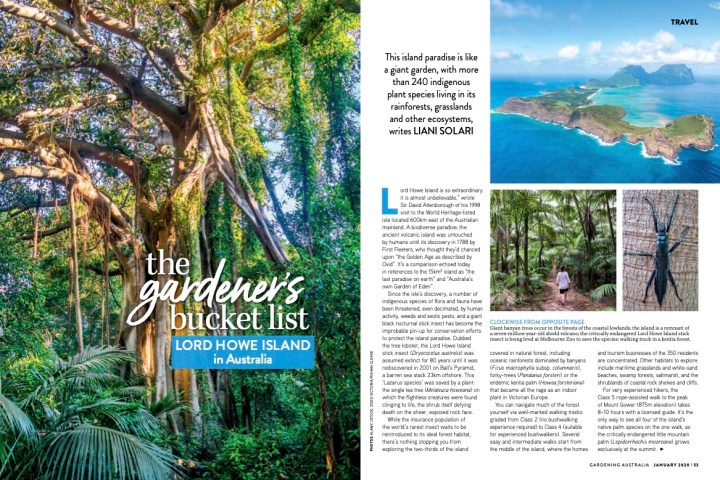
The Gardener’s Bucket List: Lord Howe Island
Words by Liani Solari
Published in ABC Gardening Australia magazine, January 2020
More than 240 indigenous plant species live in the rainforests, grasslands and other ecosystems of this biodiverse paradise. Read more
-
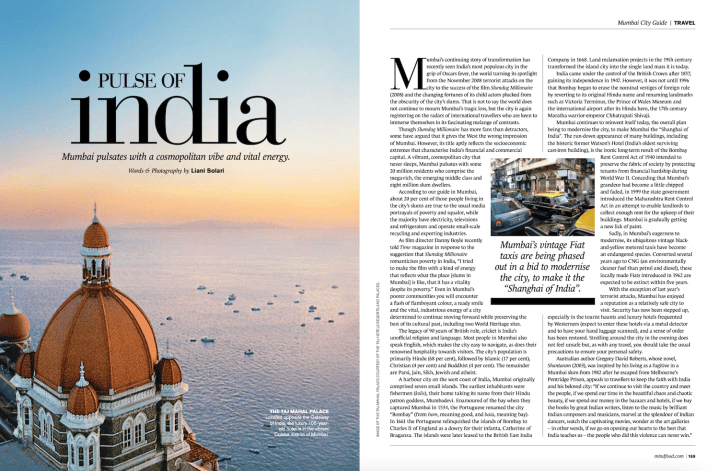
Mumbai city guide
Words and photography by Liani Solari
Published in MiNDFOOD magazine, May 2009
India’s most populous city – the backdrop to Slumdog Millionaire – pulsates with a cosmopolitan vibe and vital energy. Read more
-
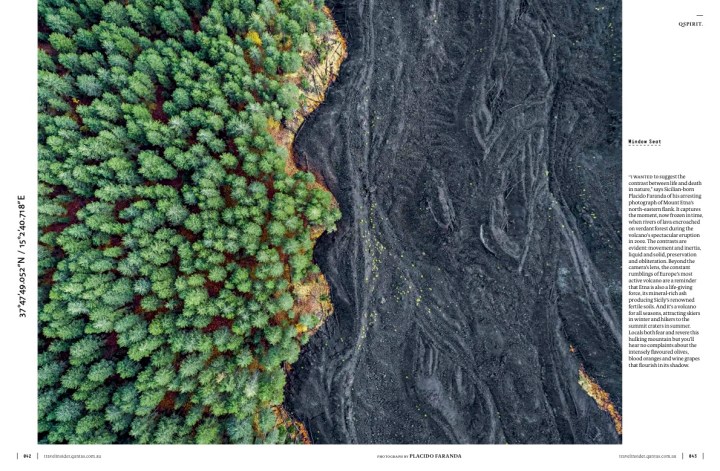
Window Seat photo prompt: Mount Etna, Sicily
Words by Liani Solari • Photograph by Placido Faranda
Published in Qantas’s inflight magazine, January 2018
“I wanted to suggest the contrast between life and death in nature,” says Sicilian-born Placido Faranda of his arresting photograph of the volcano’s north-eastern flank. Read more
-
Daytripping with Dalí
Use Barcelona as your base to cross over to the “unsuspected and hallucinatory world of surrealism” in Figueres, Spain.
Words and photography by Liani Solari
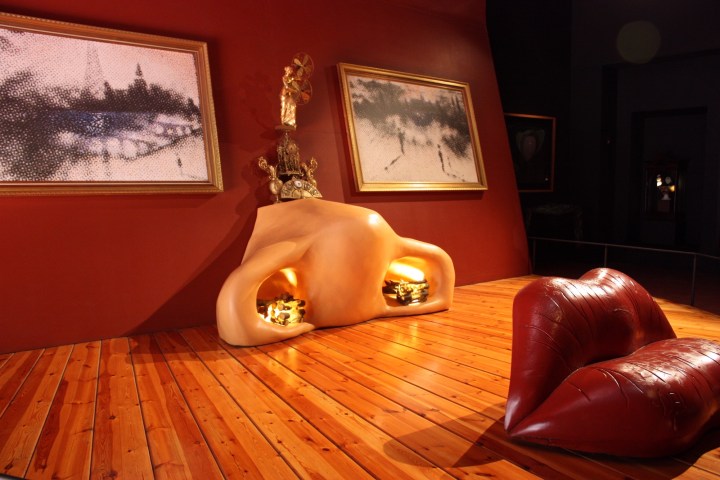
Mae West was the queen of quips. This fact was not lost on Salvador Dalí when the Catalan artist devoted a room to the 1930s American actor in his Dalí Theatre-Museum in Figueres, north-eastern Spain. Keeping in mind that West believed it was “better to be looked over than overlooked”, visitors ascend a small flight of stairs to view the room through a reduction lens. Its contents instantly meld to become West’s face: a Botox-like frozen moment with a plastic fireplace nose and Saliva-Sofa overblown lips.

Installation view, through a reduction lens, of the Mae West Room at the Dalí Theatre-Museum, Figueres, Spain, featuring Salvador Dalí Face of Mae West Which Can Be Used as an Apartment circa 1974, photo © Liani Solari We had read in a guidebook that none of Dalí’s best-known works are in his home town of Figueres, a 140-kilometre bus trip from Barcelona. However, the guide had failed to acknowledge that the Dalí Theatre-Museum – Dalí’s greatest contrivance and his final resting place – is the largest surrealist work in the world, its scale matching the largesse of its creator’s ego.
Inaugurated in 1974, the museum occupies the site of Figueres’ former municipal theatre, which was razed in 1939 at the end of the Spanish Civil War. Dalí’s choice of site was purposeful. “The municipal theatre, or what was left of it, seemed to me to be very appropriate for three reasons,” he said. “First, because I am an eminently theatrical painter; second, because the theatre is in front of the church where I was baptised; and third, because it was precisely in the lobby of the theatre that I had my first exhibition of paintings.”
In this town of Dalinian beginnings and endings, which is easily navigable on foot, it’s a 10-minute stroll from Dalí’s museum to the house in which he was born in 1904 at No. 20 Carrer del Monturiol and his family’s subsequent home in nearby Placa de la Palmera. Neither of Dalí’s childhood homes is an architectural stand-out in the Catalan modernista streetscape, unlike his museum with its deep-pink walls studded with gold bread rolls; its lofty, precariously placed giant eggs; and its crowning glory, a huge glass geodesic dome.
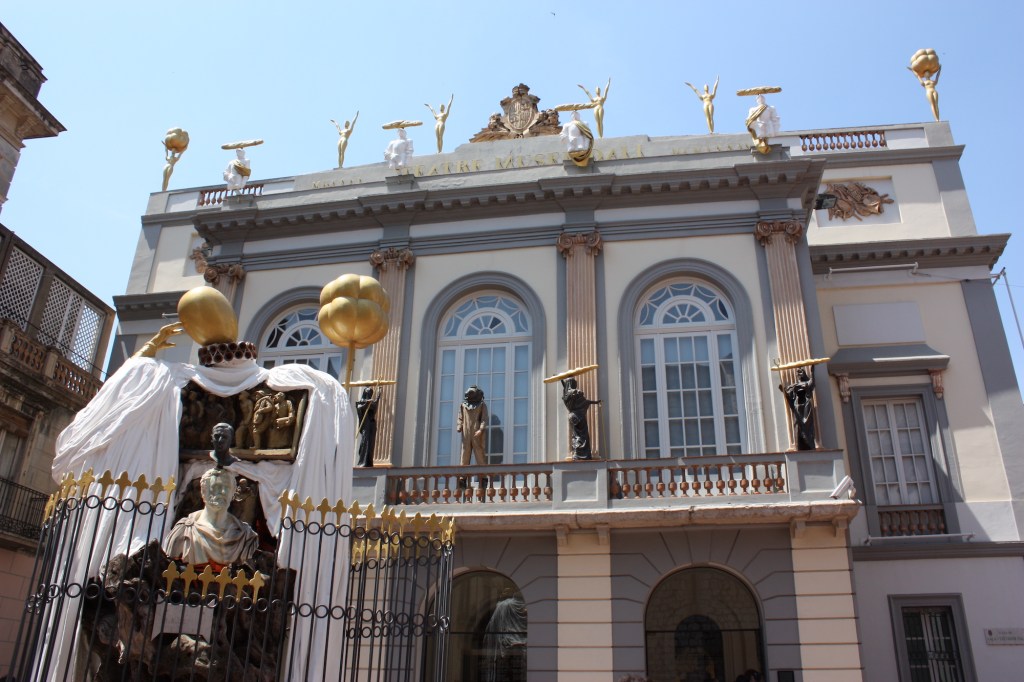
Entrance to the Dalí Theatre-Museum, Figueres, Spain, photo © Liani Solari The whimsical entrance to the museum assures us that we are crossing over to another world – “the new, unsuspected and hallucinatory world of surrealism”, as Dalí described it – which is reinforced by the museum’s advice to consider Dalí’s idiosyncrasy by not following a preconceived route. Trying to ignore that flash of panic at the possibility of missing any part of the museum, I surrender to the ride.
There’s nothing fusty about this museum experience, I realise, as I jostle with other visitors to take in every detail of Dalí’s large Rainy Taxi (1974) sculpture in the light-filled internal courtyard that used to be the theatre stalls. Beyond the courtyard, sunlight streams through the glass dome to throw a natural spotlight on the stage area, illuminating the backdrop canvas that Dalí created for the ballet Labyrinth (1941). Even in death, Dalí is the ever-present director of these scenes, guiding visitors to appreciate the many ways he has played to the museum’s origins as a theatre.

Installation view of the courtyard at the Dalí Theatre-Museum, Figueres, Spain, featuring Salvador Dalí Rainy Taxi 1974, photo © Liani Solari On this self-guided tour, I’m curious to know on what grounds Dalí’s detractors had dismissed his works as the ravings of a chaotic mind. Certainly, the 1970 documentary Soft Self-Portrait of Salvador Dalí, narrated by Orson Welles, had highlighted the outlandish behaviour and outrageous beliefs of “The Divine Dalí”, as the artist styled himself. “Dalí is not crazy!” the artist ranted at the camera before staging several happenings at his home in nearby Port Lligat. These included Dalí leading a procession of a plaster rhinoceros’s head and two children dressed as cherubs along a coastal goat track, tossing handfuls of feathers into the air; and Dalí emerging with his wife, Gala, from a giant egg on the beach, like the offspring of Leda and Zeus.
Back in the museum that Dalí opened four years later, I start in the Treasure Room with The Spectre of Sex-Appeal (1932), which Dalí completed during his surrealist period before he was expelled from the movement in 1939. This paradoxically miniature painting of the young Dalí beholding an oversized, grotesque female apparition is rendered in fascinating detail with a sure hand. Dalí was no Sunday painter. Despite being unable to apply himself to his art studies in his youth, he could apply his hallucinatory visions to canvas with almost faultless classical precision. While the subject of the painting is disquieting, its rendering is measured, considered and anything but frenzied.
It’s also in the Treasure Room that I glean further insights into Dalí’s interior world. While Dalí arguably had his demons, there are few signs of them here in his portraits of his Russian wife and muse, Gala, with whom he instantly fell in love in 1929 while she was married to French poet Paul Eluard. Gala’s image, for the most part, is immune to the grotesquerie and dismemberment that afflict so many of Dalí’s other subjects, his brush instead meditating on her unaffected beauty in the serenely poised Galarina (1945) or elevating her to the supreme object of desire in Atomic Leda (1949). Theirs was not a conventional marriage, with Dalí installing Gala in her own medieval castle in nearby Pubol in 1969, visiting her only by written invitation.
In the museum’s Fishmongers’ Room, Dalí’s portrait of Spanish artist Pablo Picasso (the two met on a trip to Paris in 1926) shares the space with Dalí’s Soft Self-Portrait with Grilled Bacon (1941). The transparently unflattering Portrait of Pablo Picasso (1947) seems intent on resisting interpretation, the full title of the painting enigmatically nodding to the “genius” of Dalí’s fellow countryman. I’m amused and frustrated in equal measure, until I remember that Dalí claimed he could never understand his own works either. “Dalí only creates enigmas!” he said. (Sorry, Picasso, it’s not really about you.)
Like fellow Catalan artisan Antoni Gaudí, whose crypt is in La Sagrada Familia in Barcelona, Dalí is buried within his greatest work. I enter the museum’s dimly lit Crypt Room, forgetting the first lesson about Dalí: expect the unexpected. The air is sombre with orthodox reverence that almost seems to flout the memory of this flamboyant personality who made a career of thumbing his nose at convention and inflaming controversy. Dalí’s tombstone, too, is a surprisingly simple, unadorned slab inscribed with stoic roman capitals.
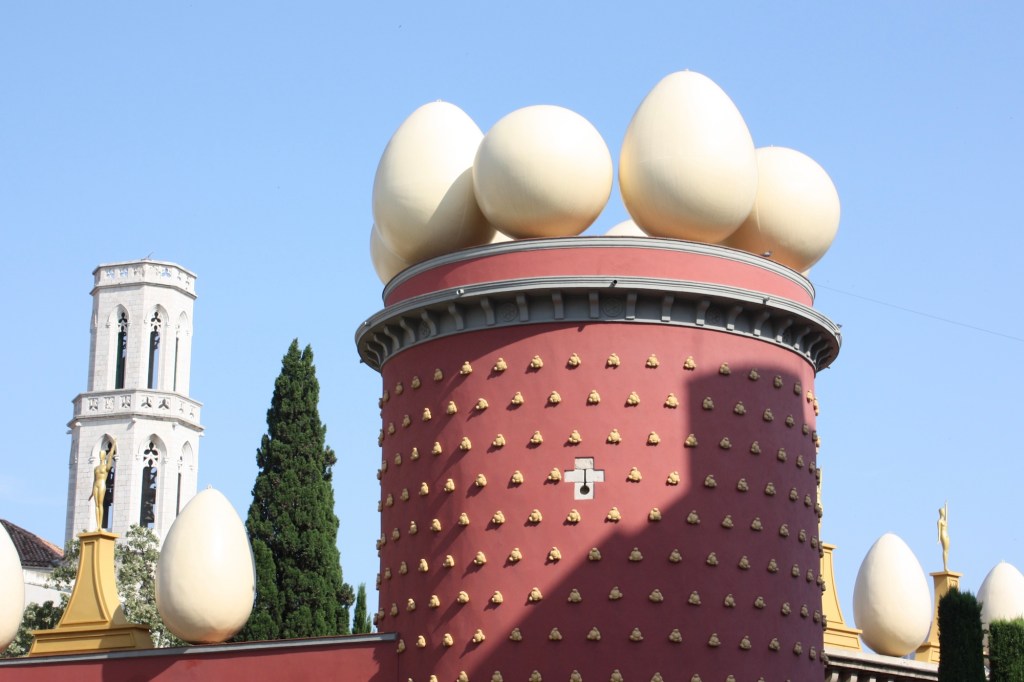
Torre Galatea (with Sant Pere’s bell tower behind), Dalí Theatre-Museum, Figueres, Spain, photo © Liani Solari On leaving the museum, we wander around the building’s perimeter and happen to look up at just the right moment: the bell tower of Dalí’s baptismal church, Sant Pere, is seemingly sprouting up from behind the museum’s egg-crowned tower, Torre Galatea, where Dalí lived for five years before he died in 1989. No other scene could so poetically encapsulate the life of this theatrical illusionist. It’s in this unexpected moment that I appreciate what writer Josep Playa Maset referred to as Dalí’s “first and last acts of a perfectly planned scenario”. Or perhaps, to borrow a line from the character of Dalí in the film Midnight in Paris, “I see a rhinoceros!”
Getting there: Catalunya Bus Turistic operates return daytrips from Barcelona to Figueres (via Girona). You can also do a virtual visit of the Dalí Theatre-Museum.
© Liani Solari
‘Daytripping with Dalí’ was originally published on Liani Solari’s Girls’ Own Adventure travel blog (now offline).
-
DIY royal visits in Scotland
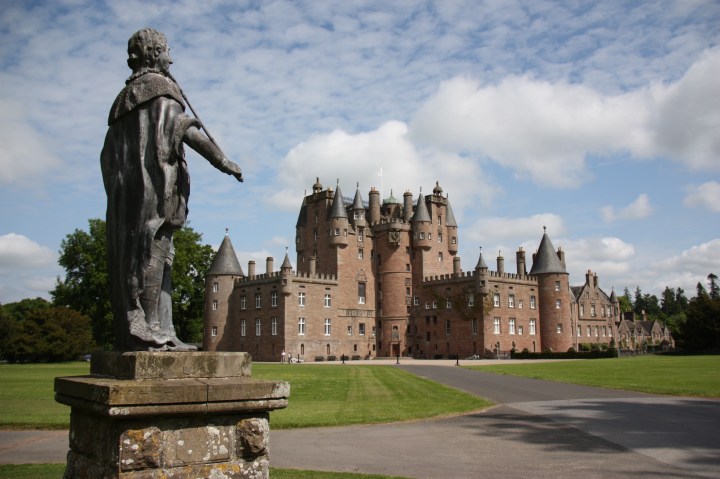
You don’t need an invitation to have a right royal time at these residences of the British Royal Family that are open to the public.
Words and photography by Liani Solari
Balmoral Castle
The royal why: Built by Queen Victoria and Prince Albert in the 1850s, Balmoral Castle is now the holiday home of Queen Elizabeth II and her family from September to November. Although the castle is not as ostentatious as you might expect, Queen Victoria described Balmoral as “my dear paradise in the Highlands”.

The grounds of Balmoral Castle, Scotland (Photograph: Liani Solari) Common ground: The ballroom is the only room in the castle that is open to the public. Watch video footage capturing the Queen’s lighter side (when she takes her then young grandchildren Zara, Beatrice, William and Harry for a pony ride around the grounds) and Prince Charles’s balding royal pate doing the dosey doe around the ballroom (thanks to the camera angle).
In the castle grounds, woe betide any weed that infiltrates the royal vegie patch, but the public is welcome to traipse around the neat plantings of mollycoddled carrots, leeks and beets.
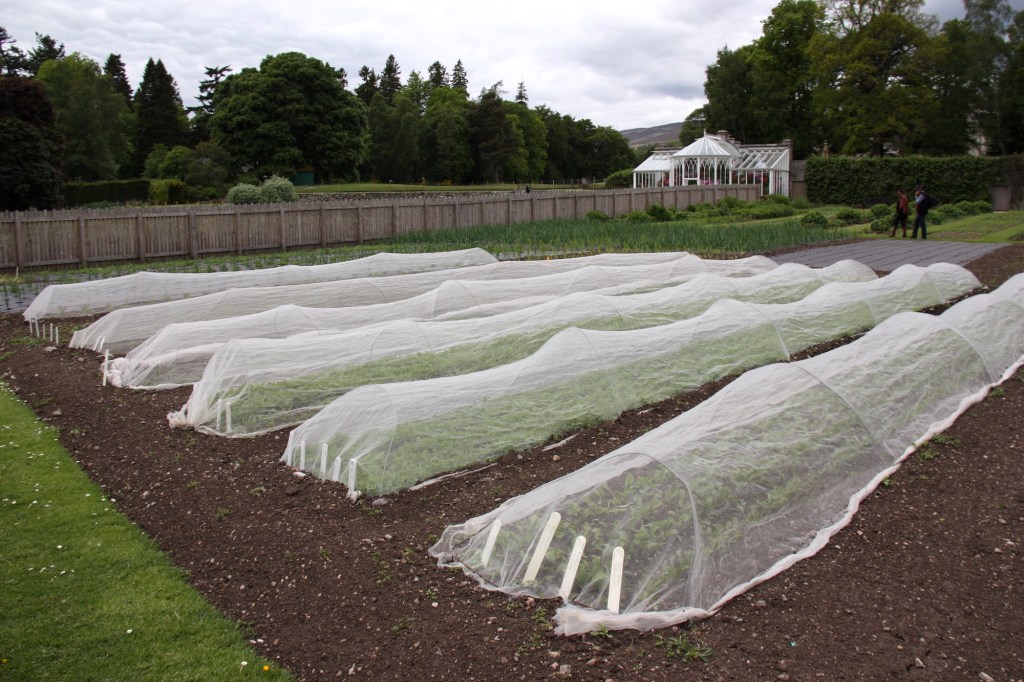
The royal vegie patch at Balmoral Castle, Scotland (Photograph: Liani Solari) Royal scandals: In autumn 2012, Prince Harry sought refuge at Balmoral from his nude-in-Vegas photo scandal, no doubt receiving a different kind of dressing-down from the powers that be.
John Brown, Queen Victoria’s rumoured lover, is buried in the old graveyard across the road from nearby Crathie Kirk, the parish church where the holidaying royals attend Sunday services.
We are not amused: In the nearby town of Ballater, royal warrants are proudly displayed by stores that supply goods to the Queen and Prince Charles. Note the wall of the Chinese takeaway displaying the Queen’s royal warrant, which really belongs to Chalmers Bakery next door.
Glamis Castle
The royal why: Glamis Castle (featured image) is the fictional residence of William Shakespeare’s Macbeth, the real-world childhood home of then commoner Elizabeth Bowes-Lyon (the late Queen Mother) and the birthplace of the late Princess Margaret. The castle is on land in Angus granted to the Bowes-Lyon family in 1372 by King Robert II. When Elizabeth was four, her father inherited Glamis Castle with the title of 14th Earl of Strathmore and Kinghorne. The fairytale-like building with its lofty turrets is reportedly the most haunted castle in Scotland.
Common ground: The 50-minute guided tour of the castle includes the family chapel, where a particular seat is always reserved for ‘the Grey Lady’, the ghost of Lady Janet Douglas of Glamis, who was burned at the stake in 1537 by King James V of Scotland on trumped-up charges of witchcraft. The castle is also said to be haunted by the spirit of ‘Earl Beardie’, who declared that he would play cards with the Devil himself into the wee small hours of Sunday when he could find no-one else in the castle who would violate the Sabbath.
Members of the public may stroll at their leisure through the picturesque grounds, keeping an eye out for red squirrels and Highland coos.
Royal scandal: In Victorian times, Glamis Castle was plagued by rumours that the first-born son and rightful heir of the 11th Earl was held captive in the castle, concealed in a secret apartment within its walls.
We are not amused: When the 18th Earl of Strathmore and Kinghorne married commoner Karen Baxter in August 2012, the Daily Mail couldn’t let sleeping corgis lie, reporting, “Twice-divorced Queen’s cousin with ‘taste for drinking and prostitutes’ weds shop manager.”
Palace of Holyroodhouse
The royal why: Located at the end of Edinburgh’s Royal Mile, the Palace of Holyroodhouse is the official residence of the Queen in Scotland, and where she receives guests in the Royal Apartments during Holyrood Week in June/July. Maintaining a tradition dating back to King George V and Queen Mary, the Queen and the Duke of Edinburgh (1921–2021) would entertain 8000 guests at a Garden Party in the grounds of the palace each summer.
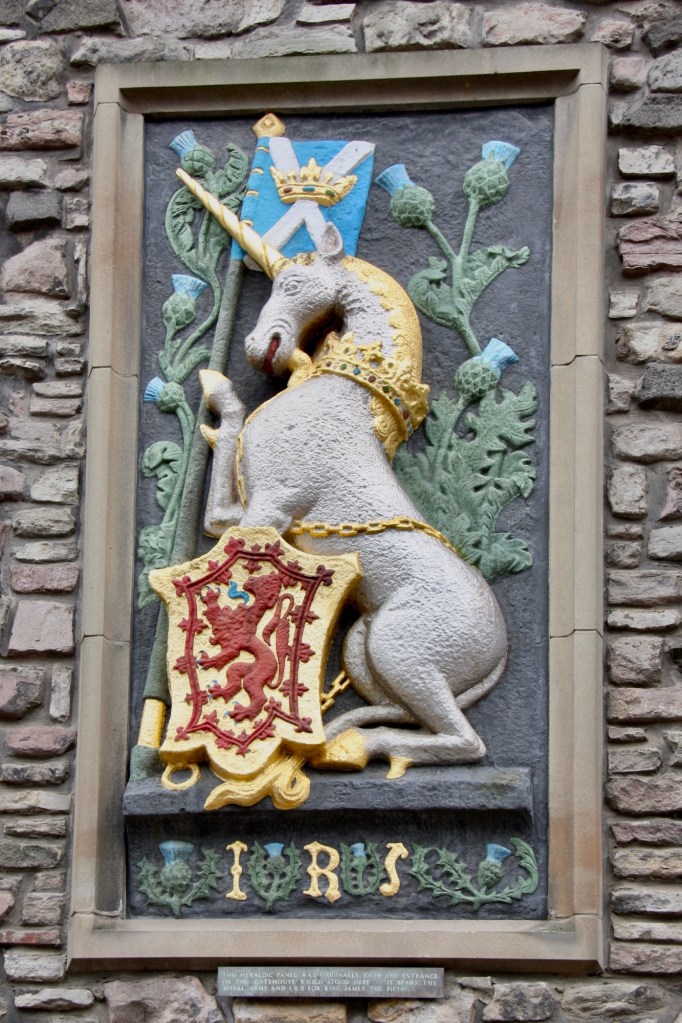
Depiction of a unicorn (the national animal of Scotland and a symbol of Scottish royalty) on a wall at the Palace of Holyroodhouse, Scotland (Photograph: Liani Solari) Common ground: The palace’s Royal Apartments and Historic Apartments are open to the public. Mary, Queen of Scots’ Bedchamber and Outer Chamber are a treasure-trove of the bedevilled 16th-century monarch’s personal possessions, including a lock of her hair, delicate needlework she completed in exile in England and a perfume pomander.
Royal scandal: Arguably the most famous room in Scotland, the Outer Chamber is where David Rizzio, Mary’s secretary, was dragged and stabbed 56 times by the queen’s jealous husband, Lord Darnley, and his henchmen.
We are most amused: In 2011, when Zara Phillips and Mike Tindall held their wedding reception at the palace, wannabe karaoke king Prince William performed Bon Jovi’s Livin’ On A Prayer. Aye, Britain’s got talent.
© Liani Solari
‘DIY royal visits in Scotland’ was originally published on Liani Solari’s Girls’ Own Adventure travel blog (now offline).
-
David Bowie is
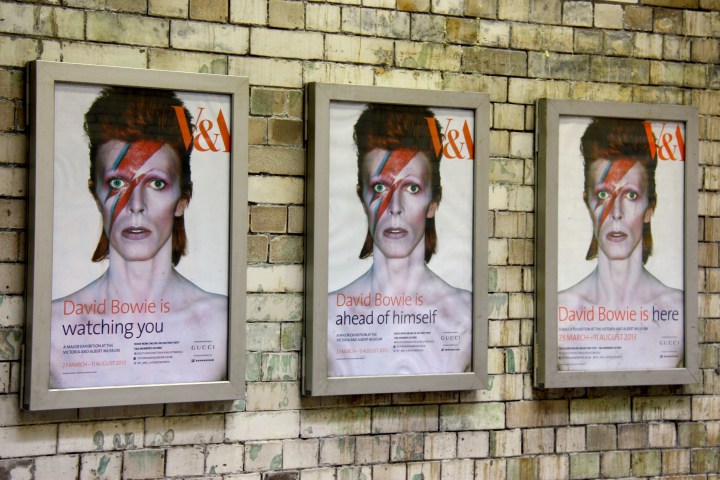
Is there anything that David Bowie isn’t? Well, yes, according to this V&A exhibition. David Bowie is not David Jones.
Words and photography by Liani Solari
‘David Bowie is’ was originally published on Liani Solari’s Girls’ Own Adventure travel blog (now offline) in May 2013. The David Bowie is exhibition toured the world from March 2013 to July 2018. Bowie died in January 2016 after releasing his final studio album, Blackstar.
Is there anything that David Bowie isn’t? Well, yes, according to the V&A’s David Bowie is exhibition. “David Bowie is not David Jones” protests a sign at the entrance. It’s confirmed by a typewritten letter, dated to 1965, from Bowie’s manager, Ralph Horton, advising, “I have now changed Davie’s name to David Bowie.” No Monkee business going on here.
Today, 48 years after he took American frontiersman Jim Bowie’s name to distinguish himself from teen idol Davy Jones of the Monkees, David Bowie is very much in the present tense. Earlier this year, the English musician released The Next Day, his first studio album in 10 years, and if the queues outside the V&A and inside the exhibition are any indication, London is in the grip of Bowie fever again.
This world-first retrospective of the serial reinventor’s five-decade career contains 300-plus objects but seems far more dense, layered as it is with video installations, an integrated audio tour and a background-music loop that runs the gamut of Bowie’s greatest hits.
Charting the rise of the boy from Brixton to the Top of the Pops, the exhibits include a black-and-white photo of a 16-year-old Bowie (then a trainee paste-up artist for an ad agency) when he had his first band, The Kon-rads. It’s a reminder of his longevity in the industry. Camera-ready and primped to within an inch of his young life, Bowie would later sing, “When you’re a boy other boys check you out,” cutting a fine figure as a drag queen (or three) in the exhibition’s screening of the video clip for Boys Keep Swinging.
As the exhibition progresses, the teenage Bowie’s blond rockabilly coif morphs into a Mick Jagger-esque ’do on the cover of Bowie’s 1967 debut album for Decca (Bowie was openly fascinated with Jagger) and then the shock of red hair he sported as Aladdin Sane in 1973 (a look immortalised on the Brixton 10-pound note).
“Bowie’s blond rockabilly coif morphs into a Mick Jagger-esque ’do and then the shock of red hair he sported as Aladdin Sane.”
There are outrageous costumes that immediately scream Bowie – the 1973 Tokyo Pop vinyl bodysuit designed by Kansai Yamamoto is a standout – along with unexpected objects and references that raise a chuckle. The framed diploma that Bowie received for entering the 2nd International Song Festival in Malta in 1969 (the year he released Space Oddity) resembles an encouragement award, while there’s nothing too cool for school about his song choice for his first BBC audition: Mary Poppins’ Chim Chim Cher-ee.
What is cool, though, is the way Bowie’s record covers are displayed, inviting us to riffle through the album sleeves as if in a vintage record store (or, for some of us, through our own vinyl collections).
Incidentally, no harm was done by Mary Poppins, with Starman launching Bowie onto the BBC’s Top of the Pops and into living rooms across England in 1972. The video of his performance, which caused a stir at the time, is displayed on a floor-to-ceiling screen behind a mannequin dressed in the Starman’s two-piece quilted suit.
The exhibition also offers rare insights into Bowie’s creative process, documenting everything from the people who inspired his overt theatricality (including avant-garde mime artist Lindsay Kemp) and use of the cut-up technique (Beat Generation writer William S. Burroughs), to his handwritten lyrics, album artwork sketches and costumes. Influenced by filmmaker Stanley Kubrick’s A Clockwork Orange, Bowie’s early costumes for Ziggy Stardust take the short bodysuit and platform boots to new heights.
Channelling the glamour of 1940s Hollywood screen siren Lauren Bacall on the cover of his 1971 album, Hunky Dory, Bowie also unwittingly took imitation to its unflattering end, incurring the annoyance of Andy Warhol with his eponymous song about the pop artist on the album. The two met just once, that same year. Watching their awkward encounter on video, I can’t imagine what Warhol would have made of Bowie wearing the dead man’s wig and glasses to play him in the film Basquiat in 1996.
Acknowledging Bowie’s many collaborators and co-conspirators, the exhibition features the Union Jack coat designed by Alexander McQueen for the Earthling album cover (1997); Bowie’s diary entry about co-writing his first American hit single, Fame, with John Lennon (1975); and Bowie’s painting of Iggy Pop from the musicians’ Berlin years in the 1970s.
In addition to Bowie’s handwritten lyrics to Starman, there’s a simulation of the Verbasizer computer program and a video of Bowie demonstrating how he uses it to write his songs. “In the ’70s he becomes fascinated by chance as a catalyst for creativity,” explains the accompanying information about Bowie’s songwriting methods. By the ’90s, Bowie’s use of the Beat-inspired cut-up technique culminates in the Verbasizer, an electronic lyrics generator. So re-inventive. So Bowie.
We leave the exhibition via a larger-than-life video of Bowie’s final Ziggy Stardust concert at London’s Hammersmith Odeon in 1973. We could almost be at a live concert. “It’s the last show that we’ll ever do,” Bowie announces to an unsuspecting audience before performing the final encore. We’ve heard that before, so should we be concerned? Let’s hope David Bowie is a doing word.
© Liani Solari
-
Window Seat photo prompt: Nockburra Creek, Murray River
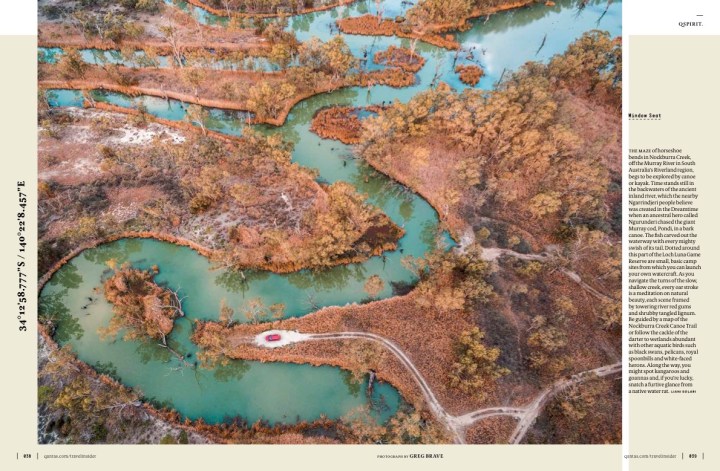
Words by Liani Solari • Photograph by Greg Brave
Published in Qantas’s inflight magazine, January 2019
As you navigate the turns of this slow, shallow creek, every oar stroke is a meditation on natural beauty. Read more
-
Hawaii’s melting pot
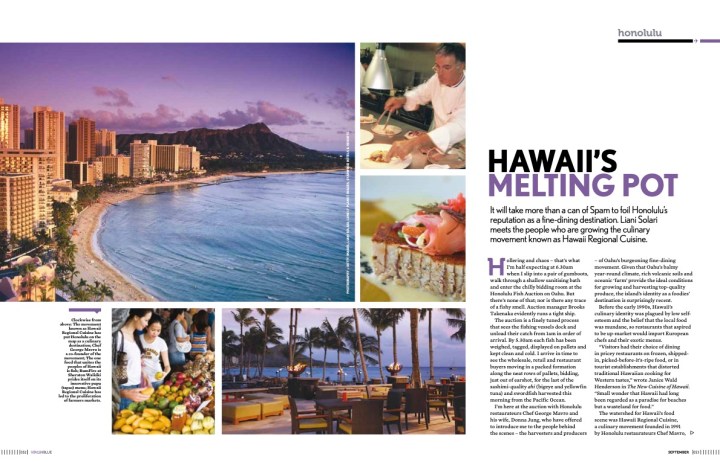
Words by Liani Solari
Published in Virgin Australia’s inflight magazine, September 2010
Meet the people who are growing the culinary movement known as Hawaii Regional Cuisine and promoting Honolulu’s reputation as a fine-dining destination. Read more
Writer • Editor • Copyeditor • Travel Writer

