
-
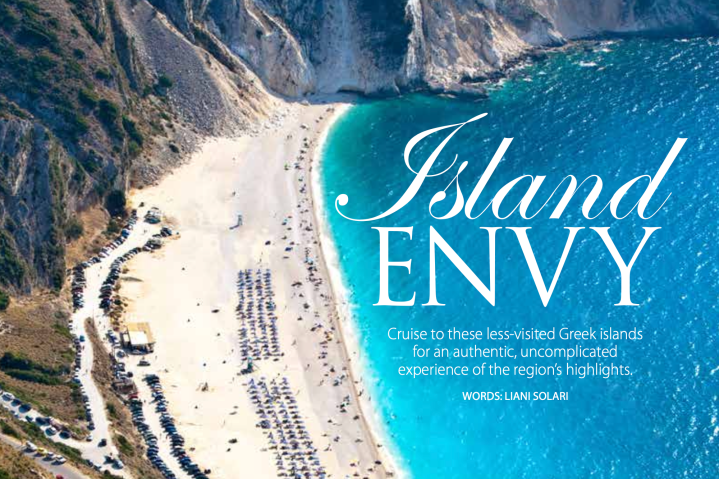
Island envy in Greece
Words by Liani Solari
Published in From The Bridge cruise magazine, March 2015
Cruise to the less-visited Greek islands for an authentic, uncomplicated experience of the region’s highlights. Read more
-
Camperdown Cemetery: A walk among the tombstones
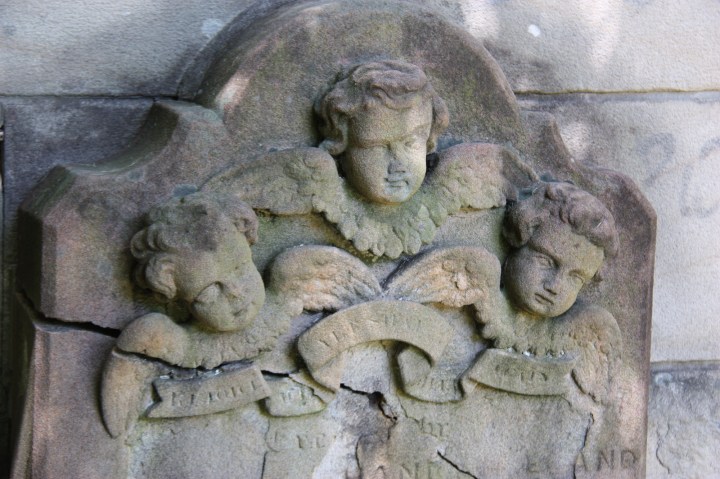
Words and photography by Liani Solari
‘Camperdown Cemetery: A walk among the tombstones’ was originally published on Liani Solari’s Girls’ Own Adventure travel blog (now offline) in 2014. Details about cemetery tours were correct at the time, but may have changed. To enquire about current tours, go to Newtown Erskineville Anglican Church.
In today’s market you’d be lucky to get change from $1 million for a terrace house in Sydney’s Inner West, but offloading land in Camperdown in the early decades of European settlement was a hard sell. Potential buyers didn’t want to live that far out from the colony!
In 1848, however, Mary Bligh, daughter of former governor William Bligh, managed to sell 12 acres to the 200 entrepreneurial businessmen who had formed the Sydney Church of England Cemetery Company. There they established Camperdown Cemetery, the colony’s third burial ground, in the suburb now known as Newtown.
Today, wading through knee-high kangaroo grass – a protected species among the decaying sandstone grave markers – you have to close your eyes to imagine what the Cemetery Company envisioned in 1848: a manicured English-style cemetery to put Sydney’s two unkempt government-run cemeteries to shame.
On most Sundays, while parishioners are pulling up a pew in St Stephen’s (the onsite church designed by architect Edmund Blacket), other locals are unpacking their picnic baskets on stone slabs in the cemetery.
Once a month, Marcelle Rodgers, the wife of St Stephen’s former rector, and archaeologist Jenna Weston conduct a two-hour walking tour of Sydney’s oldest existing European cemetery (now four acres), introducing participants to Napoleon’s harpist, a verified ghost, the victims of Australia’s Titanic story, the real Miss Havisham and many others…
Napoleon’s harpist
In 1856, opera singer Anna Bishop erected what can only be described as a Victorian death monument – with all the histrionics that implies – to her lover, Nicholas Bochsa. Nicholas had been the imperial harpist to Emperor Napoleon of France and had given lessons to Empress Josephine, fuelling a passion for harp-playing among Parisian ladies.
In 1817, to avoid 12 years’ imprisonment for forgery, Nicholas fled to England, where he was a big hit in London. There he met composer Sir Henry Bishop and his young opera singer wife, Anna. Nicholas and Anna ran off together, touring Europe and America before taking their highly anticipated act to Australia. However, they gave just one concert in the colony before Nicholas died.
Crowned with Anna’s self-portrait (rendered headless by vandals), Nicholas’ memorial in Camperdown Cemetery declares Anna’s “sincere devotedness” as his “faithful friend and pupil”. But, judging from the extravagance of the piece, local stonemason John Roote Andrews had read between the lines.
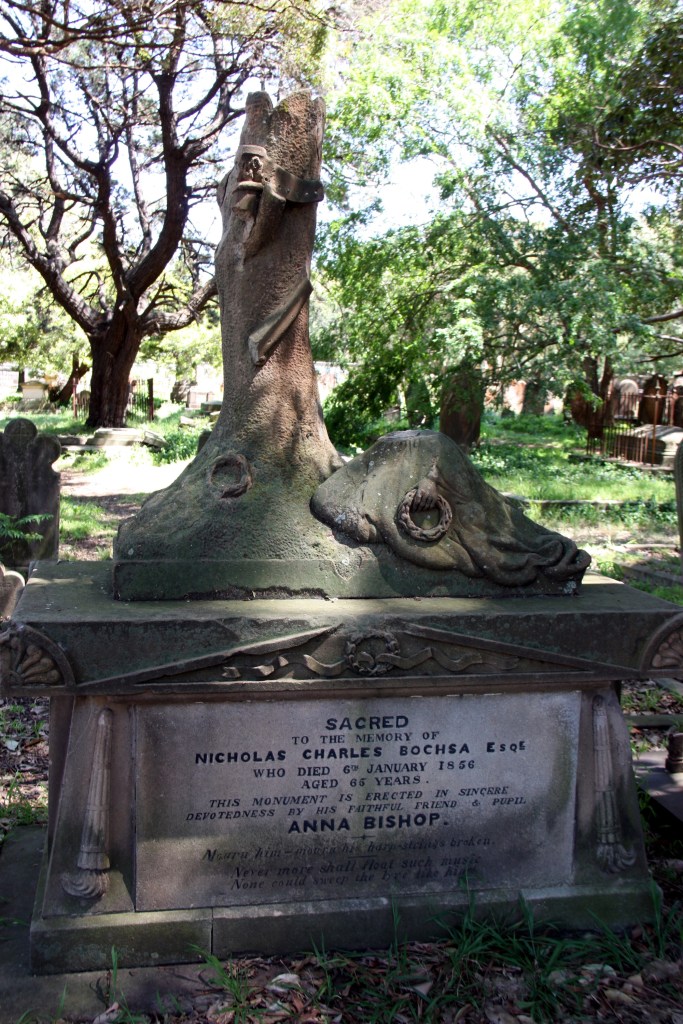
Grave monument to Nicholas Bochsa in Camperdown Cemetery, Sydney (Photo © Liani Solari) Mr Eternity’s serendipity
The headstone of Lieutenant John Putland – Governor Bligh’s aide-de-camp and Mary Bligh’s first husband – was homeless for a time, not unlike the man who inadvertently led to its discovery in Marcelle Rodgers’ garage when she lived next door to Camperdown Cemetery.
The find was made about 10 years ago when a film crew was working in the cemetery on a documentary about Arthur Stace, aka ‘Mr Eternity’. Arthur, who led an itinerant lifestyle and suffered from alcoholism, was inspired by a preacher at the Burton Street Tabernacle in Darlinghurst to chalk the word ‘Eternity’ in perfect copperplate on the streets of Sydney, from 1932 until his death in 1967.
The film crew wanted to chalk the word ‘Eternity’ on the back of a headstone. Rather than disturb anything in the cemetery, Marcelle agreed to bring out a headstone that was stored in her garage, without taking notice of the inscription to Putland. “The next week, people started knocking on my door, saying, ‘You won’t believe what’s turned up in the cemetery – an important historical piece!’” she recalls.
Putland’s headstone predates Camperdown Cemetery by 40 years, and no-one quite knows how it got there. Historians suspect that, like Mr Eternity, it had done the rounds in Sydney.
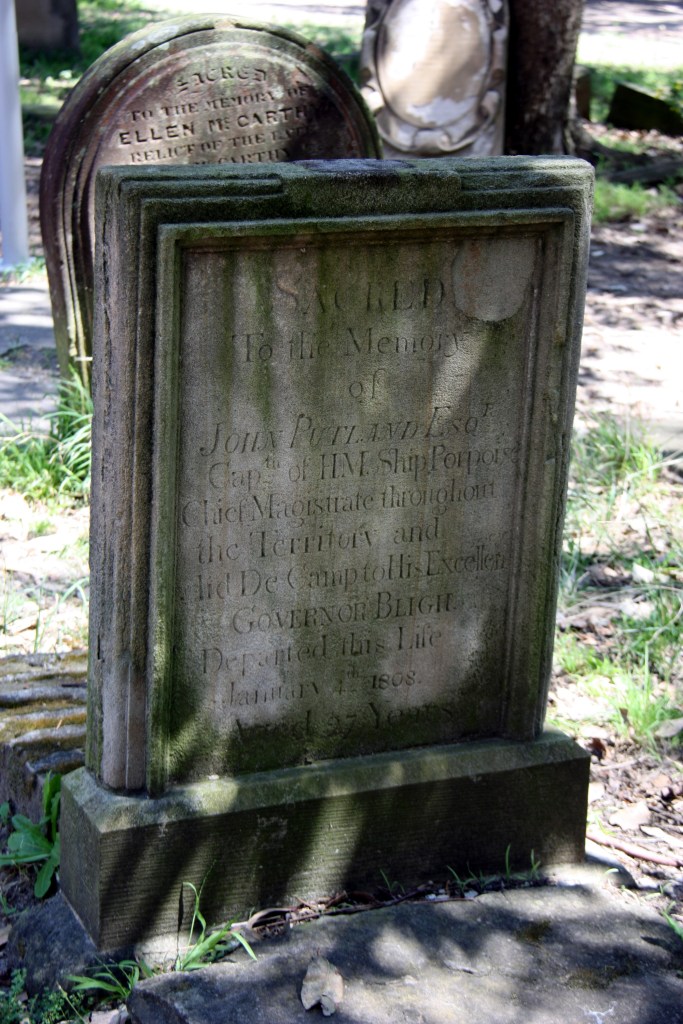
Headstone of John Putland in Camperdown Cemetery, Sydney (Photo © Liani Solari) Thomas Downes and the “sham balloon ascent”
Take a closer look at the headstone of 11-year-old Thomas Downes and you’ll realise, sadly, the hot air balloon isn’t a reference to a child’s toy.
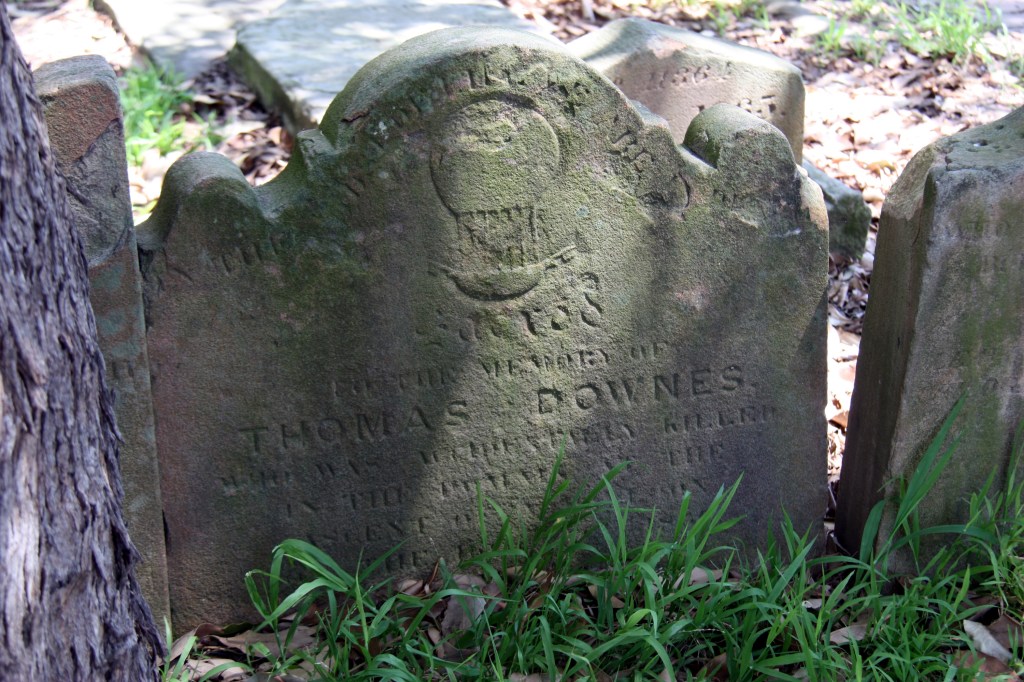
Headstone of Thomas Downes in Camperdown Cemetery, Sydney (Photo © Liani Solari) In 1856, a Frenchman, Monsieur Pierre Maigre, sold tickets to hundreds of people to watch him launch the first flight in Australia in the Domain, Sydney. It all went disastrously wrong when the balloon caught fire and didn’t rise. Accusing Maigre of ripping them off, the crowd began to riot. In the chaos that ensued, a pole anchoring the hot air balloon was knocked down, striking the Downes boy in the head. While Maigre fled, the boy was taken to the Sydney Infirmary and Dispensary, where he died from his head injuries.
Thomas’ death went before the courts, the jury concluding, “We unanimously consider that, if any person is to blame, it is Monsieur Maigre, the perpetrator of the sham balloon ascent.”
Dr Charles Nathan, the surgeon who attended to the boy at the Sydney Infirmary and Dispensary, is also buried in Camperdown Cemetery. In June 1847, he administered the first anaesthetic in Australia, which was understandably a big deal. Until then, the few operations that were possible were carried out with no pain relief; after a dose of opium and/or alcohol; or after a blow to the patient’s head that would ‘knock them out’.
Convict ghost
Camperdown Cemetery reportedly has several ghosts, but only one that can be verified: Bathsheba Ghost. In 1838, Ghost was convicted at London’s Old Bailey court of receiving stolen property. Sentenced to 14 years in the colony of New South Wales, she was forced to leave her husband and three-year-old son.
Thirteen years into her sentence, Ghost was appointed to one of the most prominent and well-paid positions available to a woman in the colony: matron of the Sydney Infirmary and Dispensary. Along with Dr Charles Nathan, she attended to the boy fatally injured in the hot air balloon incident.
Ghost remained in Sydney and never remarried. It is not known what happened to her husband, however, towards the end of her life, her son immigrated to Australia and she came to know her grand-daughter.
Australia’s own Titanic
Towards the far corner of Camperdown Cemetery is a mass grave for the victims of the Dunbar shipwreck. Some refer to the Dunbar tragedy as ‘Australia’s Titanic story’, but given that it occurred in 1857 (the Titanic sank in 1912), perhaps the Titanic should be ‘Ireland’s Dunbar story’?
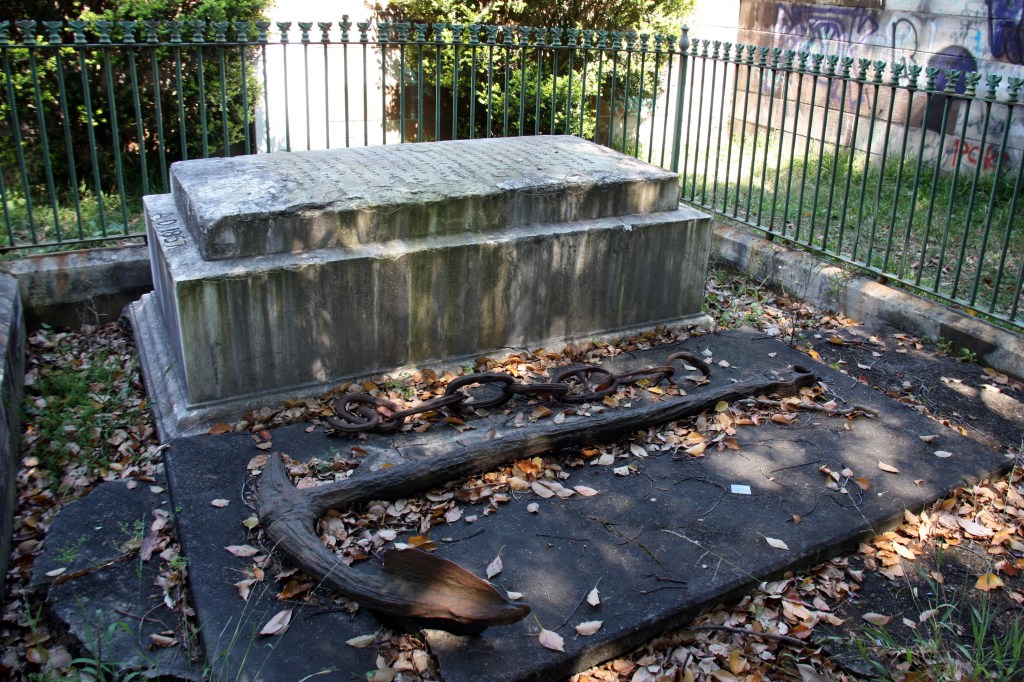
Mass grave of the Dunbar shipwreck victims in Camperdown Cemetery, Sydney (Photo © Liani Solari) Unlike the ships of the First and Second Fleets crammed with convicts, the Dunbar was an English sailing ship bringing upper-class passengers and their servants back to Australia. On its second voyage to the colony, disaster struck.
At about midnight on 20 August 1857, during an east coast low, Captain Green made a fatal error: he thought he was guiding the ship into Sydney Harbour, but he was a kilometre off course. A massive wave smashed the ship against the wall of the Gap at Watsons Bay, and within a couple of waves the ship was destroyed.
All but one of the 122 people on board perished. Miraculously, crewman James Johnson was washed up on a ledge at the Gap, where he spent two days before he was seen and rescued. James later became a lighthouse keeper up the coast at Nobbys Beach, Newcastle – where, the story goes, he saved the sole survivor of a shipwreck, like himself.
While you won’t find the Dunbar’s sole survivor in this cemetery, you will find another love triangle and a ghost story. Next to the Dunbar mass grave is that of Captain John Steane, also a victim of the Dunbar. His body was among the handful recovered intact, so he was given an individual burial. Just a couple of metres away, within eyeshot, is the grave of John’s alleged lover, Hannah Watson, and her husband, Captain Thomas Watson, the Harbour Master of Port Jackson.
According to the story, when Thomas discovered his wife’s infidelity, he cursed the lovers. Hannah wrote to John, begging him not to return to Sydney, but it was too late – he had already set sail on the Dunbar. While the ill-fated lovers were never reunited in life, Hannah’s ghost has reportedly been seen drifting from the tomb she shares with her husband to the grave of her lover.
The real Miss Havisham?
When her well-to-do father, James Donnithorne, died in 1852, Eliza Donnithorne inherited most of his estate, including their home, Cambridge Hall (no longer extant), at 36 King Street, Newtown.
Four years later, Eliza was to marry shipping clerk George Cuthbertson. However, on the morning of the wedding when all was ready – the bride decked out in her gown, the wedding breakfast laid out, the guests assembled – George failed to turn up.
From that time on, the jilted bride never left the house, opening the door only to a select few and taking refuge in books. The wedding breakfast remained on the dining table, gradually decaying. Eliza died in the house 30 years later, aged 60, and was buried in Camperdown Cemetery with her father.
Sound familiar? Eliza Donnithorne bears an uncanny resemblance to the eccentric recluse Miss Havisham in Charles Dickens’ novel Great Expectations. Though no-one can be sure if Eliza was the real-life inspiration for Miss Havisham, the Dickens Society in England gave Eliza the benefit of the doubt and money towards the restoration of her granite headstone when it was knocked over and broken in 2004.
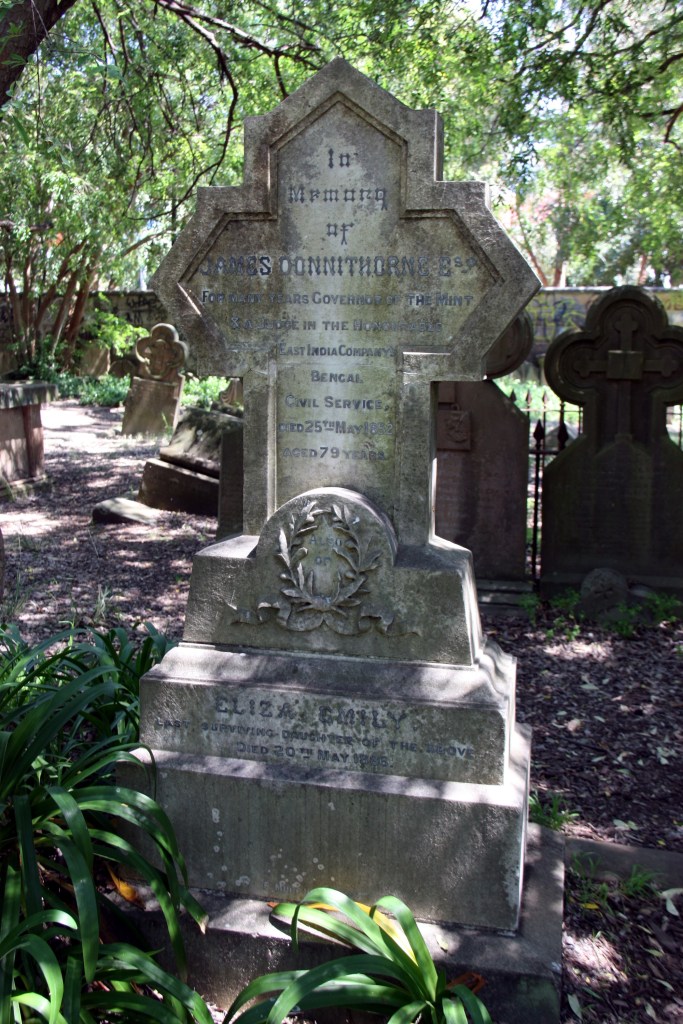
Headstone of Eliza Donnithorne and her father, James, in Camperdown Cemetery, Sydney (Photo © Liani Solari) Dickens published Great Expectations four years after Eliza was jilted. You have to wonder if she read his novel while she was holed up in Cambridge Hall. If so, did she recognise shades of herself in Miss Havisham? Today, ironically, the slab next to the gravestone of reclusive Eliza is a popular picnic table.
© Liani Solari
-
In good voice: Interview with k.d. lang
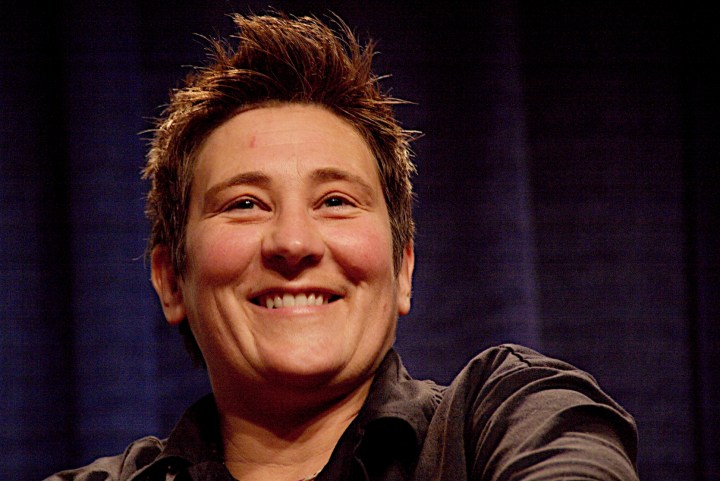
Interview by Liani Solari
Published on mindfood.com, 8 December 2008. Image: “kd lang” by Charlie Llewellin is licensed under CC BY-SA 2.0.
Enjoying the success of her first self-produced album, Watershed, and accompanying tour, Canadian singer-songwriter k.d. lang speaks with Liani Solari about her 25-year career.
LS: Writing and producing your own album, as you did with Watershed, is very different to interpreting other artists’ songs…
KD: Sometimes I don’t feel the inspiration to write but I do feel like singing. Both are challenging and both are important to me as a musician. As a vocalist it’s good to interpret the work of others; as a songwriter it’s good to write, to use more emotion. I identify more strongly as a vocalist than a songwriter.
In addition to your own songs, you’ve included a live version of your interpretation of Leonard Cohen’s Hallelujah on Watershed. Can we anticipate a duet with “the ever-provocative Mr Leonard Cohen”?
Oh, I don’t know. No, probably not a duet. He certainly can hold his own with that song.
You’ve been fortunate to have had mentors such as Miss Peggy Lee [1920–2002]. How did her mentoring come about?
I just started listening to her as a kid, around the age of 20. I never got tired of her vocal style and interpretive humour [lang performs Lee’s Don’t Smoke in Bed on the Live in London DVD]. I was fortunate enough to meet her in the late ’80s. She was an amazing woman – very, very metaphysical.
Your success is lauded by the media, the music industry and your fans. How do you measure your own success?
I think it’s moderate. After 25 years in the music business, I’m fortunate to have a job! A career in the music business is difficult to maintain, so I don’t take it for granted. I don’t think I’m a superstar or anything.
How have you coped with the diminished privacy that comes with fame?
I’ve been in show business for 25 years so it [fame] has waxed and waned. It takes a while to figure out that you’re sort of in the driver’s seat – you can choose where you hang out and who you hang out with. I have a really nice balance, the best of both worlds, now.
Sunday Life magazine quoted you as saying, “There is something I’m looking forward to doing when I get to Australia [for the Watershed tour in April/May 2008] but I’m going to keep that to myself. I wouldn’t want photographers hanging around, so I’m keeping it a secret.” Are you able to reveal that secret now?
No [laughs], I’m going to keep it a secret because I like to do it every time I go!
You’ve described your journey as a vocalist in almost meditative terms: letting self-conscious thoughts fall by the wayside and focusing on the purity of the vocals. What is the ultimate goal?
I think just to enjoy it as much as I possibly can, and hopefully that enjoyment will transcend to the people listening to it. Music is a transportive experience and the goal is just to enjoy it. It’s that simple, really.
You became a Buddhist practitioner and started writing Watershed at around the age of 40. Do you feel you’ve reached a stage in your life where you can reconcile perfectionism with just letting the music be?
Well, I would say that’s definitely my aspiration. I don’t think I’ll ever really reach that, though. Artists need to always be striving for something.
Watershed was six years in the making. Do you ever become impatient with your art?
No, not impatient. Maybe complacent.
How do you shake off that complacency?
Well, with a bottle of wine [laughs]. White, generally. Red is too hard on the voice.
You have a painting studio at home. What medium, style and subject matter do you work with?
Oils, but also whatever I have. Abstract Expressionist is my style. I’m fond of the work of American Abstract Expressionists such as Franz Kline [1910–62]. In California [at the time of the interview, lang lived in Los Angeles], the strange lack of architecture is conducive to painting cityscapes and streetscapes. Because I’m not a gifted artist, only three of my paintings are good enough to be hanging on my walls at the moment.
The Dalai Lama sent a congratulatory letter to Barack Obama on his election as US President in which he mentions Obama’s “concern for the situation in Tibet”. To what extent is Obama an instrument of hope, not only for Americans but also for the rest of the world?
Oh, a tremendous hope. He is someone who has the openness, integrity and unity to be a tremendous hope for the world. I have high hopes for what he can achieve with his openness.
If you hadn’t become a musician, what would you be doing?
I would have gone into the culinary arts. It’s always been a passion.
So, if you could invite anyone to a dinner party, who would it be?
I would love to have dinner with Patsy Cline [1932–63], sit with the Dalai Lama, and have a drink with Dean Martin [1917–95].
Tell us more about your spiritual journey in the autobiographical song Jealous Dog on the Watershed album.
The first verse is about wanting things you don’t have and realising you should be grateful for what you do have. The second verse is about not fitting into Christianity, the experience of being gay. The “friend with a handsome trait” is Lama Chödak Gyatso Nubpa, my Buddhist teacher, who licks his plate in an expression of appreciation for what he has.
-
5 cultural experiences you shouldn’t miss in Venice
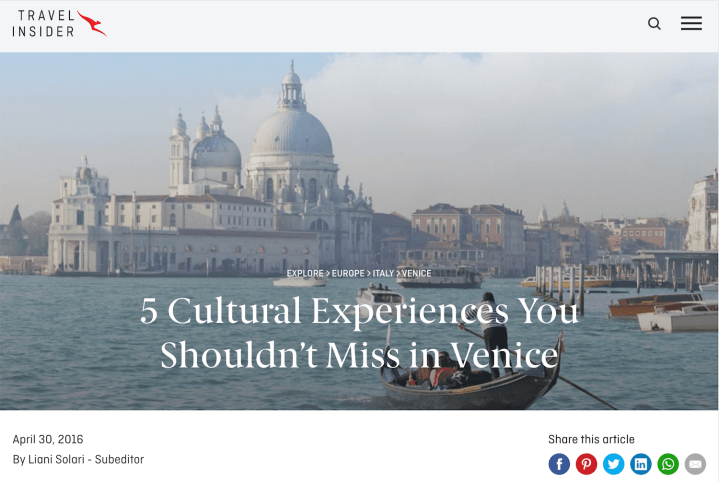
Words by Liani Solari
Published on Qantas Travel Insider, April 2016
From ghost tours and two-euro gondola rides to immersive opera, here’s a handful of lesser-known Venetian experiences.
Enjoy interactive opera
You can see a large opera production in Venice’s famous dripping-with-gold Teatro La Fenice or do an audio tour of the venue but there’s nothing quite like experiencing opera in a more intimate setting. Opera company Musica a Palazzo stages evening performances in Palazzo Barbarigo-Minotto, a now-uninhabited 15th-century palazzo near the Santa Maria del Giglio ferry stop on the Grand Canal. The walls vibrate with every soaring operatic note in this former palatial home where candlelight softens the cracks in the ceiling and stuccowork, the rough walls exposed by deteriorating silk wallpaper and the uneven terrazzo floor. The audience of about 50 follows the singers and instrumentalists from room to room as the scenes unfold, stopping for free-flowing prosecco at intermission. Our pick is Rossini’s The Barber of Seville, a comic opera driven by the antics of the barber Figaro, an unashamed wheeler-dealer. Be careful where you sit, though – Rosina, the object of affection in this comedic love triangle, openly flirts with the audience and Figaro may well plant himself in your lap.
See Australia’s new Biennale pavilion
The Venice Biennale is the world’s oldest biennial exhibition of international contemporary art and a must-do cultural event that takes over Giardini and selected venues around the city. Last year, Australia debuted its new permanent pavilion to much fanfare that included an opening ceremony attended by Cate Blanchett. The canalside box-like structure, which is clad in South Australian black granite and features a cantilever that juts out over the canal, is a fascinating study in shape-shifting architecture and a stand-out among the 29 pavilions in Giardini. In 2017, don’t miss the works of film, photography and video artist Tracey Moffatt, who will represent Australia.
Ride in a gondola for two euros
Gondola rides are notoriously expensive but what if we said you could ride in one for two euros? Traghetti are retired gondolas that have been repurposed to transport Venetians across the Grand Canal at spots where there are no bridges – but visitors in the know ride them, too. While the timber bench seats aren’t as luxurious as the padded loveseat and you won’t have the gondola to yourself, it’s a convenient and very local way to get around. To avoid being swept up in the tide of tourists beating a path from the train station, via Ponte Rialto, to Piazza San Marco, take the traghetto from the Santa Sofia stop to the Pescaria (fish market), where colourful fresh-food stalls sell all manner of seafood and seasonal fruit and vegetables.
Dine like Hemingway
Historically the haunt of artists, writers, actors, musicians, dignitaries and royals, Locanda Cipriani, on the island of Torcello, is a casually elegant dining experience far from the madding crowd. Going to Torcello for lunch is something of an undertaking if you take the ferry rather than a water taxi, so set aside enough time for a daytrip and explore colourful Burano island on the way. Of course, it will be well worth the effort when you see the brag wall of famous patrons who’ve dined at Locanda Cipriani. Ernest Hemingway famously penned Across the River and Into the Trees while staying here, his meals and drinks no doubt served with lashings of ego-stroking. Dining in the courtyard affords an unparalleled view of Torcello’s cathedral complex, where the crowning glory is a huge gold mosaic dome centred on a medieval portrait of the Madonna.
Unearth Venice’s ghosts
Discover Venice’s other haunts on a guided ghost tour of the city at dusk and be regaled by age-old tales of mystery and mayhem. Depending on the route, you might visit the merchant brothers who were turned into the stone statues in Campo dei Mori. Or you may encounter the soul of the faithful soldier who guards Garibaldi’s statue on Viale Garibaldi. As an alternative to a guided tour, obtain a copy of Venetian Legends and Ghost Stories by Alberto Toso Fei (available in English) and let it guide you into Venice’s secret corners after dark on a DIY ghost tour.
-
For the love of Sicily
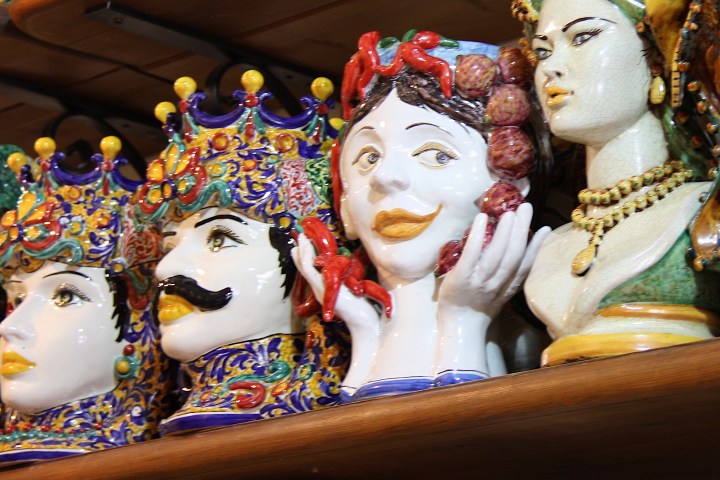
On a first trip to the Mediterranean island, it’s immediately clear that Italy’s southernmost region turns it up to 11.
Words and photography by Liani Solari
Repeat adventures in Italy have given me insights into ‘the Italian way’, but on my first trip to Sicily – a two-week circumnavigation of the Mediterranean island with my mother and an Italian-speaking GPS – it’s immediately clear that Italy’s southernmost region turns it up to 11.
Like Sicily’s incredibly vivid arancia rossa (blood orange), the region’s characteristic flavours are concentrated, distilled into an island measuring 25,460km2. Everything seems so much more pronounced. But what exactly makes Sicily so Sicilian, besides an overabundance of prickly pears and The Godfather souvenirs?
1. They know how to do the Passeggiata.
The best place in Sicily to observe the phenomenon of evening promenading is Trapani. Night after night the locals trot out plenty of attitude (but never the same outfit twice) while doing multiple laps of Via Garibaldi and Corso Vittorio Emanuele. The point of the Passeggiata is not to actually go anywhere, but to see and be seen. Like the word allora, it defies explanation.
2. There’s a beach scene.
La spiaggia (beach) is broadly defined as a patch of pebbles or a stretch of sand. Arguably the best white-sand beach resort in Sicily is Cefalu, where children play ball until dusk and crisp-skinned nonnas perfect the art of overbaking.
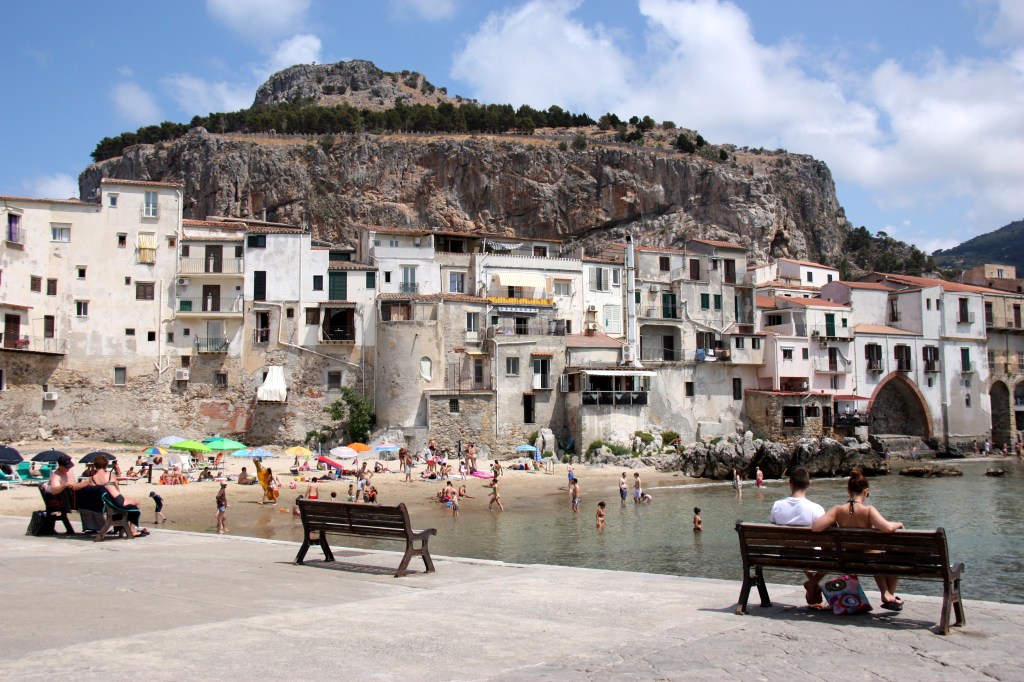
A beach in Cefalu, Sicily (Photograph: Liani Solari) 3. There’s other great old stuff.
Italy has the most UNESCO World Heritage sites in the world, with Sicily boasting six, including the Archaeological Area of Agrigento. The Greek colony of Akragas (now Agrigento) was one of the greatest cities of the ancient Mediterranean world. Today, you can still walk the talk in the Valle dei Templi (Valley of the Temples), a monumental row of Doric temples flanked by century-old olive groves.
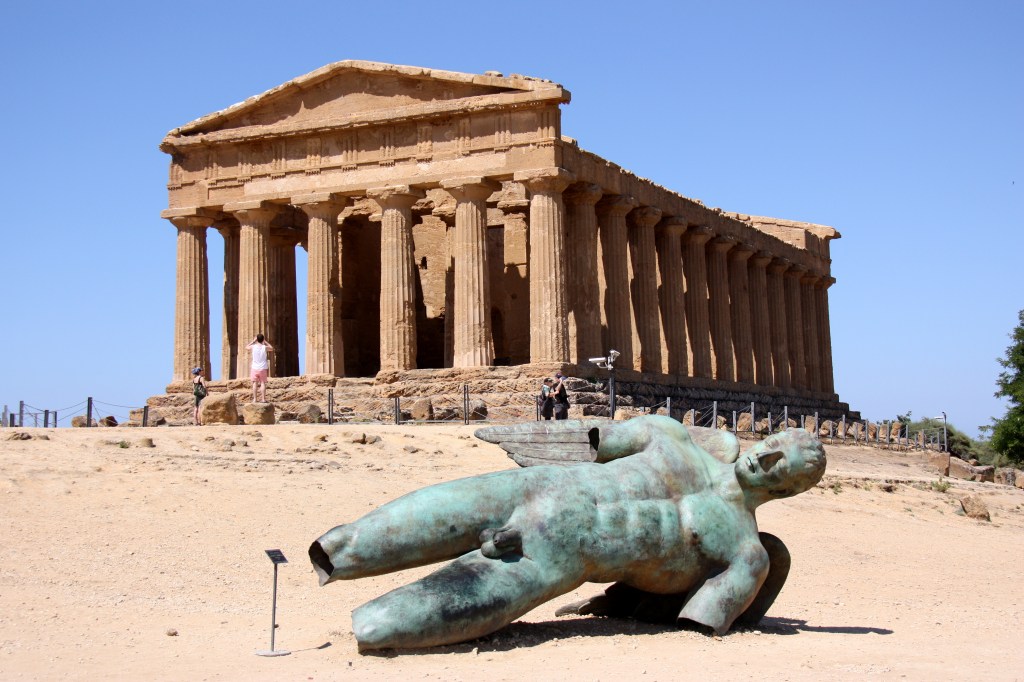
The Temple of Concordia and an Igor Mitoraj bronze in the Valley of the Temples, Agrigento, Sicily (Photograph: Liani Solari) The archaeological museum on Lipari houses an impressive collection of grave goods dating back to the Aeolian island’s ‘classical Greek’ heyday in the 5th and 4th centuries BCE. Marvel at the survival of splendid Attic red-figure pottery and the first ‘situation comedy’ character types represented by expressive miniature terracotta masks. “Lines on the forehead signify a reflective, meditative character; their absence, an empty-headed person,” says the signage explaining theatrical masks that predate the Golden Age of Botox.
4. They drive like they’re in the Targa Florio Classic.
The train system in Sicily is patchy, so get behind the wheel and strap yourself in for an interesting ride. Here’s how to navigate the road rules like a local:
- If the scenery looks blurry, it’s because the standard speed limit on the autostrade (highways) is 130km/h.
- Traffic lights will slow you down. They are just a suggestion.
- If a parking spot (designated or otherwise) isn’t big enough, it’s not a problem. Stick your nose into the space and park on a perpendicular angle to the adjacent cars. Shrug your shoulders and utter “Eh” as you walk away. If your car isn’t dented or scratched, you’re not doing it properly.
5. It’s an island.
Fish swim around it, which means fresh seafood in anyone’s language. Except for the frozen prawns (Eh).
Il Saraceno Ristorante in Cefalu does a delicious spaghetti with clams and mussels. At sunset, reserve a table on the terrazza sul mare, a timber deck that extends over the rocks to the sea, and listen to the gently lapping waves while you watch the fireball-red sun disappear behind the water.
6. It’s a celebrity hotspot.
In Taormina, celebrity spotting is a summer sport, as the annual concert series at the spectacularly sited Teatro Greco (Ancient Greek Theatre) attracts international performers.
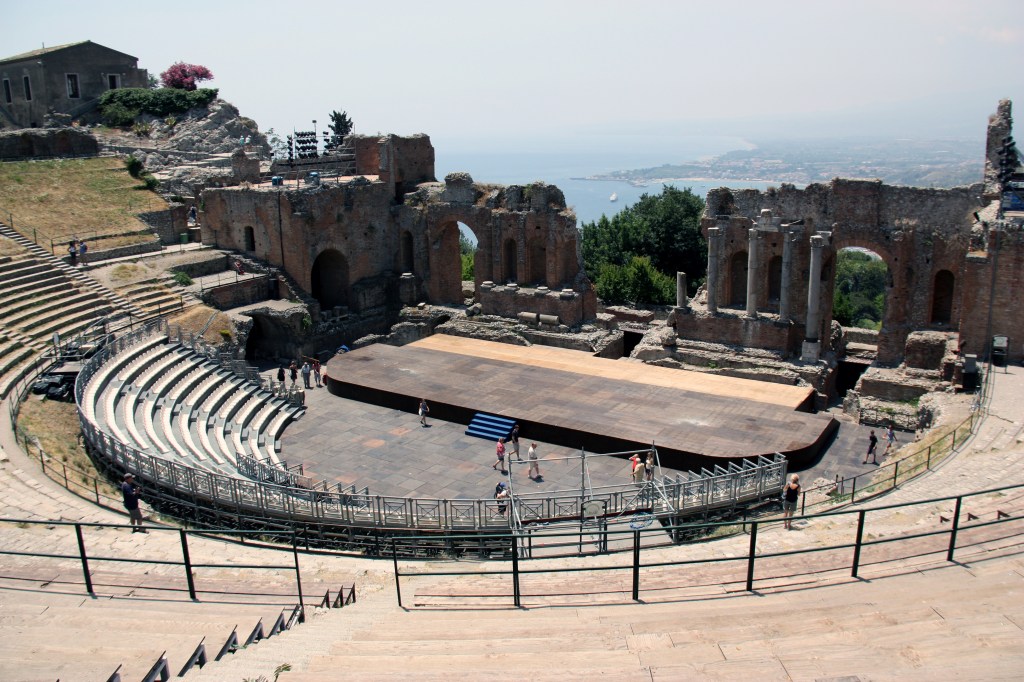
Teatro Greco (Ancient Greek Theatre) in Taormina, Sicily (Photograph: Liani Solari) A regular visitor to Sicily’s poshest town is Simple Minds frontman Jim Kerr, who owns the hotel Villa Angela. We spot his ex, Patsy Kensit, and her two sons (with Jim Kerr and Liam Gallagher) having lunch at the next table at a shady trattoria off the tourist beat. She’s in good company, as the restaurant’s brag wall of famous diners features Robert De Niro (Vito Corleone in The Godfather II), Franco Zeffirelli, Antonio Banderas, Michael Douglas and John Malkovich.
“The clams were amazing!” Patsy gushes to the nonna in charge, who responds by holding the English actor in an affectionate headlock between a hirsute armpit and a grandmotherly bosom.
Sure, travelling in Sicily sometimes requires a bit of effort, but if you embrace her, she’ll hug you back. What’s not to love about that?
© Liani Solari
‘For the love of Sicily’ was originally published on Liani Solari’s Girls’ Own Adventure travel blog (now offline).
-
Counting her blessings: Interview with Frances O’Connor
Interview by Liani Solari
Published on mindfood.com, August 2009.
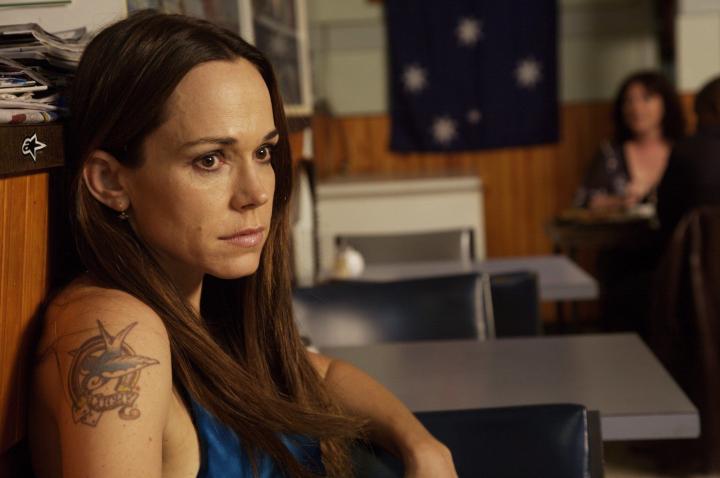
Image: Frances O’Connor playing Rhonda in the film Blessed (Head Gear Films / Album / Alamy Stock Photo). Blessed was released in Australian cinemas on 10 September 2009.
In director Ana Kokkinos’s latest film, Blessed, seven troubled children wander the streets for a day and a night in an attempt to find their way home. When dawn breaks, the audience experiences their journeys from the perspectives of their mothers. Australian actor Frances O’Connor plays Rhonda, a mother who has negligible parenting skills but genuinely loves her children, insisting they are her “blessings”.
On the eve of the release of Blessed, Frances O’Connor speaks with Liani Solari about onscreen and real-life motherhood and her passion for acting.
LS: As a mother [O’Connor has a son, Luka, 4], how did you get into the headspace of playing a character who has negligible parenting skills?
FO: When you’re representing any character, you start with what you can understand about them. Playing Rhonda involved understanding her history to explain why she is the way she is. I don’t think she was mothered particularly well herself. She is stuck in a vicious circle that continues from generation to generation. Even though Rhonda is not a very good mother, she does love her children, which was something I could hang onto when I was playing her.
What else did you draw upon to portray Rhonda with empathy?
If you’re playing a character that has some issues, you can’t really judge that character, because no-one would want to watch a character like that. You have to find something in the character that you understand. Everybody starts out as a child, as basically a good person, so the question is: how did Rhonda get to where she is? I don’t see her as a bad person. I see her more as a victim of what happened to her as a child, which has been perpetuated in her [adult] life. I kind of feel sorry for her.
There is a scene in Blessed in which your character finds herself in a situation that is inconceivable for a parent. How did you prepare yourself for that scene?
It was really hard to know how to get in there. It’s the kind of situation that every mother dreads. Every mother has, at some point, thought, “Oh my God, if that ever happened, it would just kill me.” So I drew upon that instinct.
Your role in Blessed is remarkably different from other roles you’ve played in film and television…
That makes it kind of fun. I like to do that in my professional life, to play roles that are different, to be in different cultures, to play different situations. It makes it more interesting for me.
How do you measure your success as an actor?
Like anything, there are always moments when you think, “Oh, I wish I’d done that differently,” but I’ve really enjoyed all the roles I’ve played. Now that I’m a mother, my priorities have changed slightly in terms of how I view my work. I think that’s quite healthy; it’s a healthy progression. When you’re a mother and you get back to work and start focusing on it again, you’re less precious about it. I think it relaxes your work, and your work actually expands rather than shrinks.
How do you cope with fame?
With the kind of level that I’m at, it’s doable. In America [O’Connor lives in Los Angeles], if I’m in a shop, for instance, people will come up to me and say, “Oh, I like your work,” but it’s not invasive. Luka wouldn’t even be aware of it. I’m quite a private person anyway. I’ve never really courted [fame], I’ve just enjoyed the acting side of it, so it’s a good balance.
Was there ever any question about becoming an actor?
I like writing as well, but I really am an actor. Probably since I was five, it’s what I wanted to do. I always loved using my imagination and pretending. That’s really what an actor does, I guess.
It’s great to be able to earn a living doing something you love…
It’s been a good ride so far; I can’t complain. Thank God I found out that acting was my thing to do. I remember the first time I got a job as an actor, I thought, “Oh my God, I actually get paid for this!”
For you to say yes to a script, what criteria does it need to meet?
Sometimes a script isn’t perfect but the people attached to it are really interesting, and you think, “Well, there’s enough potential in this script and the people around it are really good, so it’s worth jumping in there.” Or sometimes a script is brilliant but one of the other elements is not so good. If the script is not so good, I don’t think there’s any point in doing it, because it’s really hard, almost impossible, to fix a script on the job. The script has to be good.
What attracted you to the Blessed script?
I’ve always loved Ana Kokkinos as a director and I’ve loved her films. And I think Andrew Bovell is a really talented writer. The script was just perfect from the first sentence to the last. It was just the most beautiful script and the characters were so beautifully written. I really liked the character [Rhonda] because there were so many complexities to play. I thought it would be a real challenge, which is what you’re looking for as an actor, and I felt up for a challenge.
When I was doing [television series] Cashmere Mafia, that was the perfect job while Luka was a two-year-old; I just wanted to work on something that was fun and light. I think it’s very hard to split yourself. They [young children] need so much of you. I hadn’t really felt like getting back in there until about a year ago. Before that, I wasn’t really in the right headspace to do something heavy.
What was the best thing about working with Ana Kokkinos?
She was very passionate about the project and she was really detailed about it. The thing that helps you focus as an actor is when someone has their eye on you in terms of really watching what you’re doing and drawing it out of you. It ultimately paid off, and I think everyone really enjoyed working like that.
Blessed was filmed in Melbourne. How did it feel to be back in Australia [O’Connor was raised in Perth] co-starring with Aussie actors Miranda Otto, Deborra-Lee Furness and Tasma Walton?
Well, we never actually got to hang out at all because Ana made four separate films [in one]. I left and then Miranda arrived. So I never really got to see anybody. This week we finally got together, which was nice. Working in Melbourne was great because it feels very familiar, and working with an Australian crew was so comfortable.
What are the most striking differences between your upbringing in Perth and your son’s upbringing in Los Angeles?
He’s learning baseball, which is hilarious! But the thing about California is the people are very laid-back in a way that is similar to Australia, which is really nice.
What is your greatest challenge as a working mum?
Just trying to be present, because usually when you’re at work you’re thinking about your kid, and when you’re with your kid you’re thinking about your work. It’s really hard to just be present where you are. As a mother, you split yourself in a lot of different directions.
You and your partner, Gerald Lepkowski, have been together for 15 years. What is the key to a good relationship?
Low expectations [laughs]. No, not really. Seriously, I think the key is not being too hard on your partner and not expecting too much from them, and just accepting them for who they are. It’s your main friendship, really, so it’s about being good to the other person. I really do think that is the key. We’re human beings, so we don’t expect to be perfect.
What is the greatest thing that being a parent has taught you?
It helps you to be in the moment a lot more. When you’re single, you’re always thinking about what’s coming up, but with a kid you’re forced to slow down and just be with them. I really enjoy doing that and discovering things again as they do. You laugh a lot more when you have a kid.
-
Kitchen Confidential: Kimberley flair
Words by Liani Solari
Published in REX’s inflight magazine, June 2012
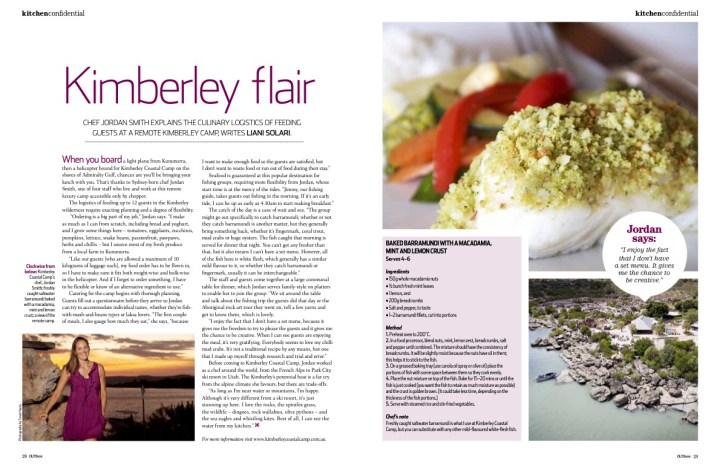
Chef Jordan Smith explains the culinary logistics of feeding guests at a remote Kimberley camp. Read more
-
Tech Talk: Interview with Michael Hooper

Interview by Liani Solari
Published in Qantas’s inflight magazine and on Qantas Travel Insider, June 2016
The Qantas Wallabies vice-captain admits he’s old-school about some technologies – yet he can’t wait for a completely wireless future. Read more
-
Get back to nature on Lord Howe Island
Words by Liani Solari
Published in Qantas’s inflight magazine and on Qantas Travel Insider, March 2017
This speck in the Tasman Sea hosts a remarkable rollcall of life forms found nowhere else. Read more
-
Greek Islands: Gods behaving badly
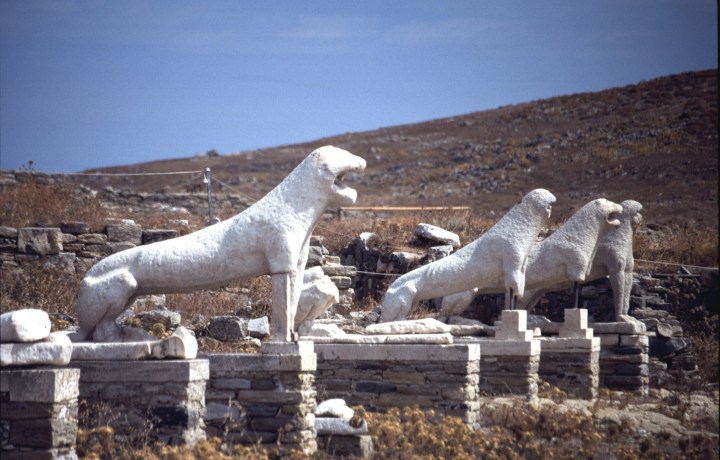
The ancient dramas on Delos – the isle of Apollo, god of the sun – would put today’s island reality shows in the shade.
Words and photography by Liani Solari
Adapted from the feature published in WellBeing magazine’s Escape Guide, November 2005
Featured image: “Delos (XII)” by ISAWNYU is licensed under CC BY 2.0
Zeus, lord of the Olympian gods and a notorious predator, had again incurred the wrath of his goddess-wife Hera with his extramarital exploits. Wreaking vengeance on her latest hapless rival, Hera prohibited the titaness Leto, who was pregnant to Zeus, from settling anywhere in the world.
Forced to wander the earth in search of a secure place to give birth, Leto eventually found refuge on the island of Delos – itself a wanderer beneath the Aegean Sea until the god Poseidon called it forth from the deep and Zeus fastened it to the seabed with chains (which, according to popular belief, rendered the island immune to the area’s frequent earthquakes). Leaning against a palm tree and enduring a difficult labour of nine days and nights, Leto gave birth to her divine twins: Apollo, god of the sun, archery, music, poetry, oracles and healing; and Artemis, the virgin huntress and goddess of the moon.
Having granted Leto asylum, this island of meagre size and means – a barren and almost waterless 3km2 rock of gneiss and granite in the centre of the Cyclades archipelago – would become the most sacred of the Cycladic islands, the political centre of the Aegean and a flourishing cosmopolitan port. In 1990, UNESCO inscribed Delos, now uninhabited but for a handful of archaeologists, on the World Heritage List for its great cultural and historical value.
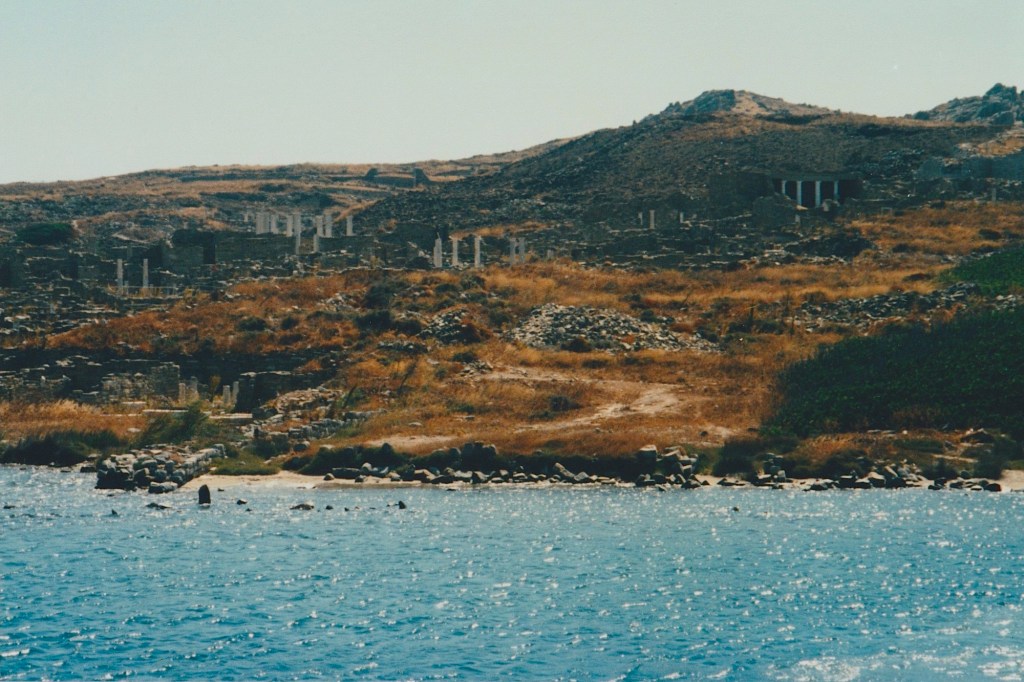
Ruins of the ancient commercial port, Delos, Greece (Photograph: Liani Solari) Leap of faith
The island derives its name from the Greek word delos, meaning to manifest, make clear, evident or plain – a reference to Delos being raised from the deep by Poseidon. It seems apt that the Greek language has also given us the word psychedelic (from psyche, meaning mind, and deloun, from delos) to describe hallucinogenic states, as the prevalence of age-old herculean feats of engineering in Greece can make you wonder if you’ve lost your marbles.
Given the indistinct perception of time that living side by side with the ancients must encourage, it isn’t difficult to fathom why parts of Greece, particularly the islands, tend to operate on ‘ish’ time. And, of course, for any custodian of archaeological evidence of global interest, there’s always that fine balance between forging ahead and preserving antiquity. Nothing, however, ever gets in the way of a good story about the gods behaving badly.
Today, for the residents of a country where you could stub your toe on a temple ruin on your way to work, there’s little doubt Greece’s glorious heroes and the gods on Mount Olympus existed. Visit the temple of Poseidon at Cape Sounio, near Athens, and your guide will take you to the “exact spot” on the precipice where Aegeus, erroneously believing his heroic son Theseus had fallen victim to the beastly Minotaur of Crete, leapt into the sea, thus giving the Aegean its name. Despite 90 per cent of the population being Greek Orthodox Christian, modern-day Greece relishes its rich legacy of pre-Christian narratives, which continue to inform its mindset and captivate its visitors.
The rise of Delos’s son
“I think you [Delos] will never be rich in oxen and sheep, nor bear vintage nor yet produce plants abundantly. But if you have the temple of far-shooting Apollo, all men will bring you hecatombs [sacrifices] and gather here … and you will feed those who dwell in you from the hand of strangers; for truly your own soil is not rich,” prophesised Leto in the Homeric Hymn to Delian Apollo, dated to the 8th century BCE.
Incredibly, this tiny island that lacked inherent resources to support its inhabitants began to emerge as the pre-eminent seat of Apollo’s worship in the same century, attracting pilgrims and patrons from all over the Aegean. Today, almost the entire island is covered in the relics of Delos’s glory days, luring modern-day pilgrims from around the world to this archaeological site comprising three temples to Apollo, abundant temples and monuments to foreign and other Greek deities (including Hera), agoras, treasuries, altars, opulent houses with fine mosaic floors, a hippodrome, stadium and gymnasium, and a theatre that could hold up to 5500 spectators.
While settlement on Delos can be traced back to the Early Bronze Age, the island was later colonised by Ionians (Greeks spread throughout the Cyclades, Asia Minor, Attica and Euboea) who, in the 8th century BCE, began to celebrate the birth of Apollo on Delos with an annual festival of games, singing and dancing. The festival was attended by all Ionians, such was the importance of the island as the principal cult centre of the Aegean.
In the 7th century BCE, the nearby islands of Naxos and Paros – sources of superior marble – were Delos’s most notable patrons. The Naxians, who were thought to control the island at the time, dedicated to Apollo a colossal statue of the god and an estimated nine to 16 marble lions, which flanked the sanctuary’s original approach, the Terrace of the Lions.
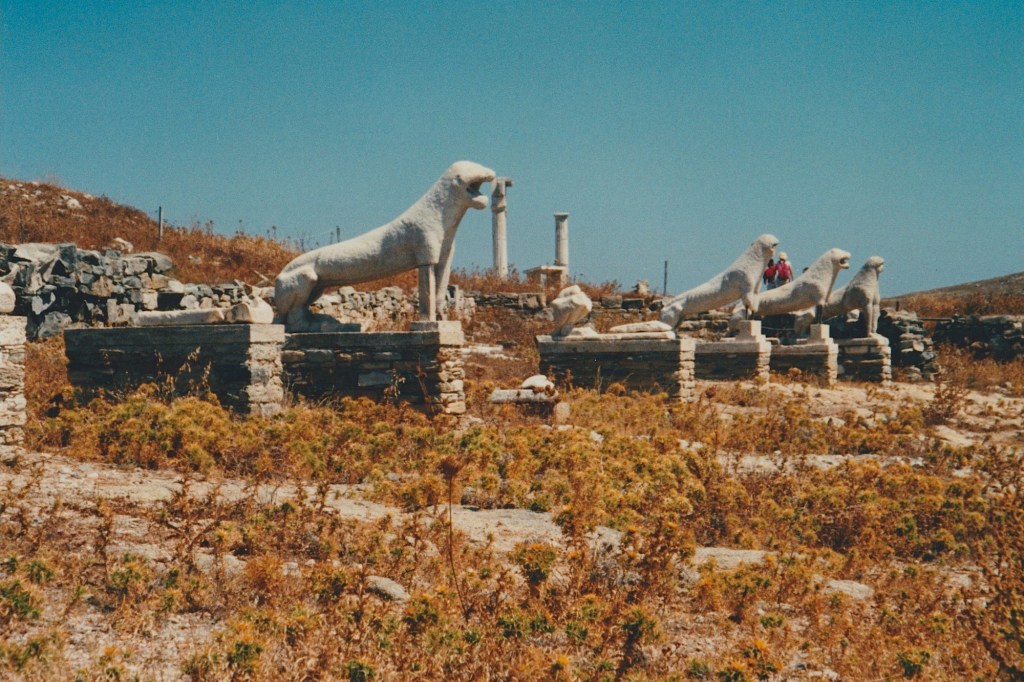
Terrace of the Lions (original statues), Delos, Greece (Photograph: Liani Solari) These leonine guardians of the sanctuary – now weathered ‘sightless’ and numbering only five – were magnificent in carrying out their charge, silently roaring across the island’s Sacred Lake. In 1999, the original statues were replaced with replicas and moved to the onsite archaeological museum to protect them from being further ravaged by the sea air and strong winds. In 1925, the Sacred Lake was filled in because of the danger of malaria, and a palm tree planted in the centre in reference to Apollo and Artemis’s birth.

Sacred Lake, Delos, Greece (Photograph: Liani Solari) ‘Purifying’ the island
Fleeing Delos during Persia’s attack on Greece in 490 BCE, the Delians left Apollo’s sanctuary (and the riches it had amassed as a major cult centre) defenceless except for its reputation. Amazingly, Delos’s fame proved to be all the fortification it needed to remain inviolate, for the Persian commander Datis, hearing the island was the birthplace of two pre-eminent deities (the sun and the moon), would not allow the ships of his invasion force to touch its sacred shores.
In 478 BCE, Apollo’s sacred isle boasted another momentous birth – that of the Delian League, the precursor to the Athenian Empire. Led by Athens, this maritime alliance of the Greek city-states against Persia had its headquarters on Delos, where regular meetings of the allies were held and the treasury of the alliance was initially located.
With Athens the dominant force, Delos was temporarily troubled by xenophobia when the Athenians banished the Delians from the island in 422 BCE on a charge of impurity. (Unlike today’s understanding of the term xenophobia – from the Greek xenoi, meaning foreigners or aliens – the word xenoi specifically referred to non-Athenians.) Thanks to Apollo, the Delians were recalled when Athens attributed its subsequent misfortunes in the Peloponnesian War to having angered the god by banishing his devotees from the island.
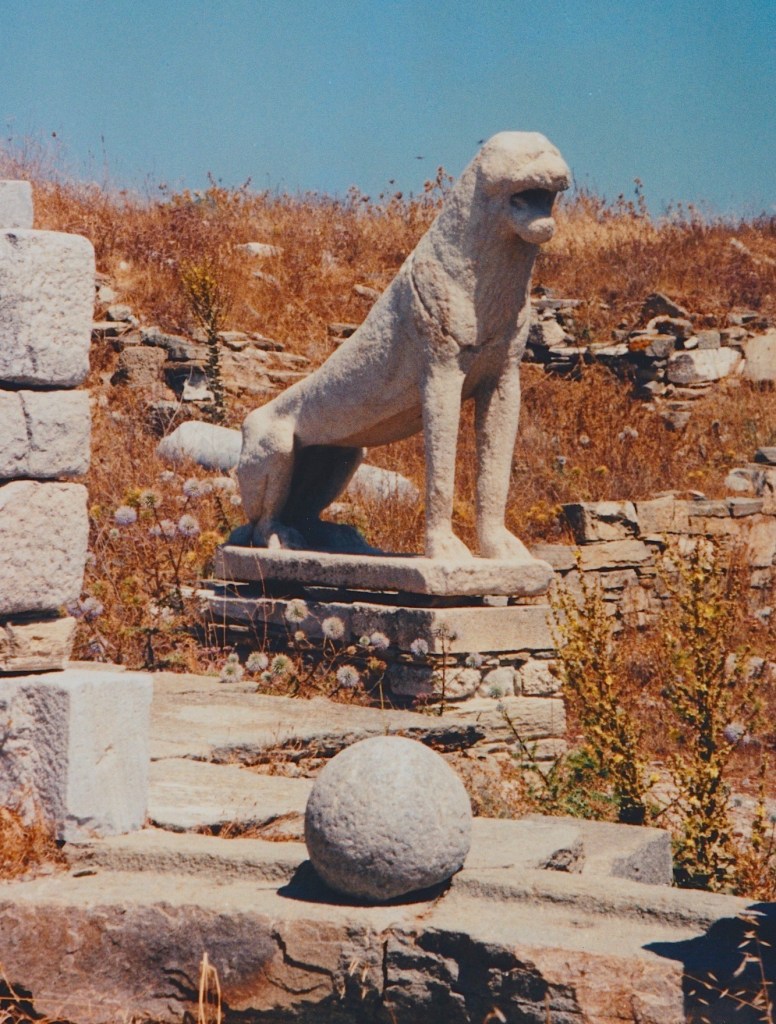
Terrace of the Lions (original statue), Delos, Greece (Photograph: Liani Solari) You have to wonder if the island’s inhabitants were also troubled by thalassophobia, thanatophobia and tocophobia – fear of the sea, dying and childbirth, respectively. In 426 BCE, Athens ‘purified’ Delos by clearing all the burials on the island and depositing the remains in a ‘purification pit’ on the nearby island of Rheneia. Deaths and births were consequently prohibited on Delos (ironic, considering Delos was the only place in the world to offer pregnant Leto refuge), so the dying and women about to give birth were taken to Rheneia. Today, sailing across the notoriously choppy channel between Delos and Rheneia, I can only begin to imagine their trauma.
“But all, except their sun, is set”
Ideally located on the trade routes from Greece and Italy to the East, Delos enjoyed a time of immense growth as a prosperous cosmopolitan trading centre before its decline in the 1st century BCE. Declared a free port in 167 BCE, the island attracted merchants, bankers and mariners from other Mediterranean lands, including Egypt and Syria. They made Delos their home, and Apollo shared his sanctuary with their foreign deities. During this period, the isle of the sun revealed a shadow side, too, as the principal market for the slave trade. Up to 10,000 slaves were traded per day, according to Greek historian Strabo (1st century BCE).
Finally destroyed and plundered by pirates in 69 BCE, Delos was unable to regain its former splendour. In 1873, the French School at Athens began unearthing the glory that was Delos, and continues to do so today. Earlier that century, English Romantic poet Lord Byron (1788–1824), renowned as much for his extravagant lifestyle and many love affairs as his work, had immortalised Delos in The Isles of Greece:
The isles of Greece! the isles of Greece!
Where burning Sappho loved and sung,
Where grew the arts of war and peace,
Where Delos rose and Phoebus [Apollo] sprung!
Eternal summer gilds them yet,
But all, except their sun, is set.Possessing Apollo’s gift of poetry and a fancy for emulating the gods in being “mad, bad, and dangerous to know”, Byron had an affinity with Greece’s sun-drenched isles that might not seem particularly remarkable. What is remarkable, though, is just how prophetic Byron’s words would prove to be, as light continues to be shed on the golden days of Apollo’s sacred isle with every passing century.
Delos is a 30-minute boat trip from the island of Mykonos. Guided tours are available, however, there is no accommodation on Delos.
Photographs (except featured image) © Liani Solari
Writer • Editor • Copyeditor • Travel Writer

