
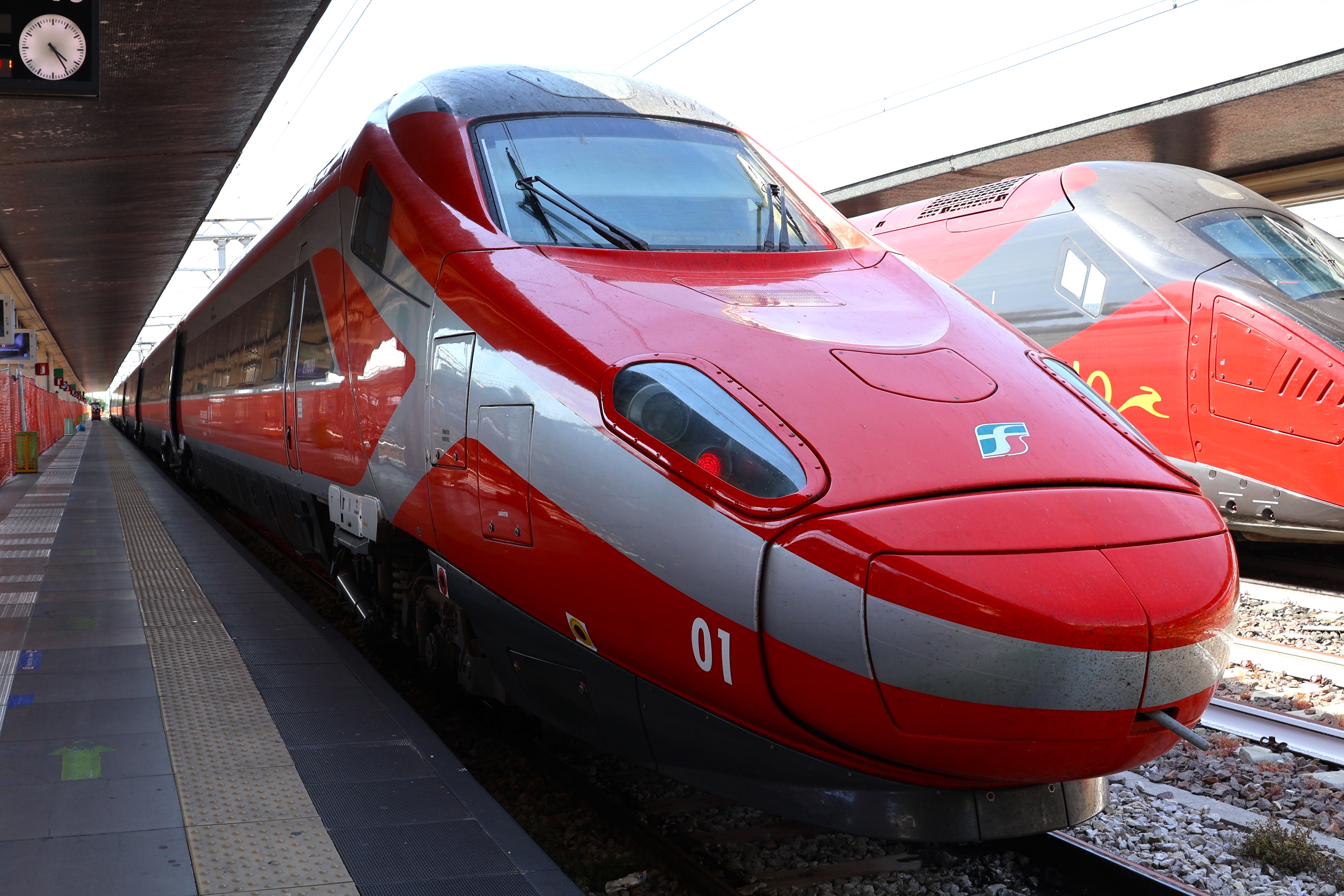
As an alternative to flying to Venice, the Frecciarossa ETR 600 train is not only fast but greener to boot. Time for the influencers to get on board.
Words and photography by Liani Solari
There’s a perception that travelling to Venice by train is the transport equivalent of cucina povera compared with the glamour of flying to Marco Polo Airport and taking an eye-wateringly expensive taxi boat into Venice proper, six kilometres away. Those influencer likes don’t come cheap.
But can I just say this: either way, you’ve arrived. Taking the Frecciarossa (Red Arrow) high-speed train really deserves more likes for being a pleasant, efficient and environmentally sustainable way to arrive in Venice itself, at a transport hub where you simply roll your luggage out of the station and onto a Grand Canal ferry to your accommodation.
As former flyers to Venice, my mother and I decide to put the fast train to the test this summer. Here’s a snapshot of what to expect when you choose this greener transport option.
Six regions in one day
We board the Frecciarossa ETR 600 at Brindisi Centrale, the second stop on the 7am direct service from Lecce to Venezia Santa Lucia (pictured above). Scooting along the east coast of Italy’s boot from heel to top, we traverse six regions (about 700 kilometres) from Puglia to Veneto in eight hours and 45 minutes. In summer, Trenitalia SpA operates two direct Frecciarossa services daily (FR 8816 and FR 8828).
Carbon footprint
According to EcoPassenger, the carbon emissions for this train trip are 44.3 kilograms per person, compared with 181.7 kilograms each if we’d flown. By taking the train instead of flying, we’re reducing our CO2 emissions by 75 per cent.
Booking
Business class is the premier level of service on the Frecciarossa ETR 600. We book online with Australian-based company International Rail four months in advance, paying €85.90 per person for non-refundable business class tickets. That’s cheaper than a 30-minute Venetian gondola ride. We’re automatically allocated seats 11D and 12D in coach 2 at the time of booking. (See the seating plan at The Man in Seat 61.)
Boarding and baggage
Our tickets for this high-speed train don’t need to be validated before boarding because they have a specific date, time and seats. However, that’s not the case for all rail travel in Italy, so it pays to check.
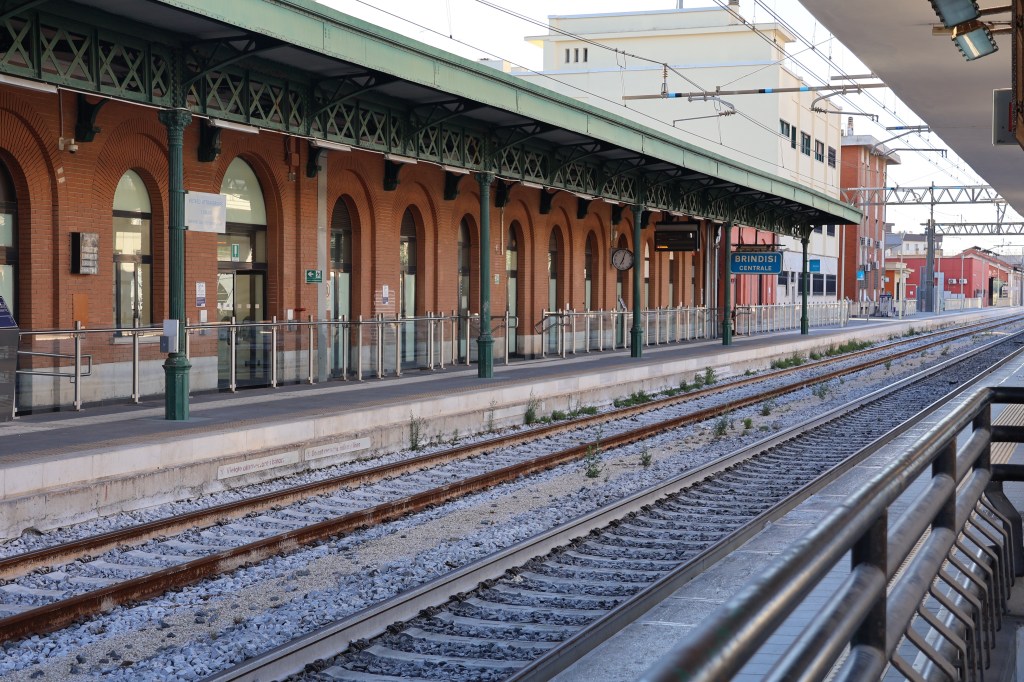
Coach numbers displayed on the platform at Brindisi Centrale take the guesswork and stress out of knowing where to board when the train pulls in. We have lovely locals to thank for helping us lug our two 20-kilogram suitcases up two dozen steps to the platform (there’s no lift) and up four steps into the carriage (most trains in Italy are not flush with the platform).
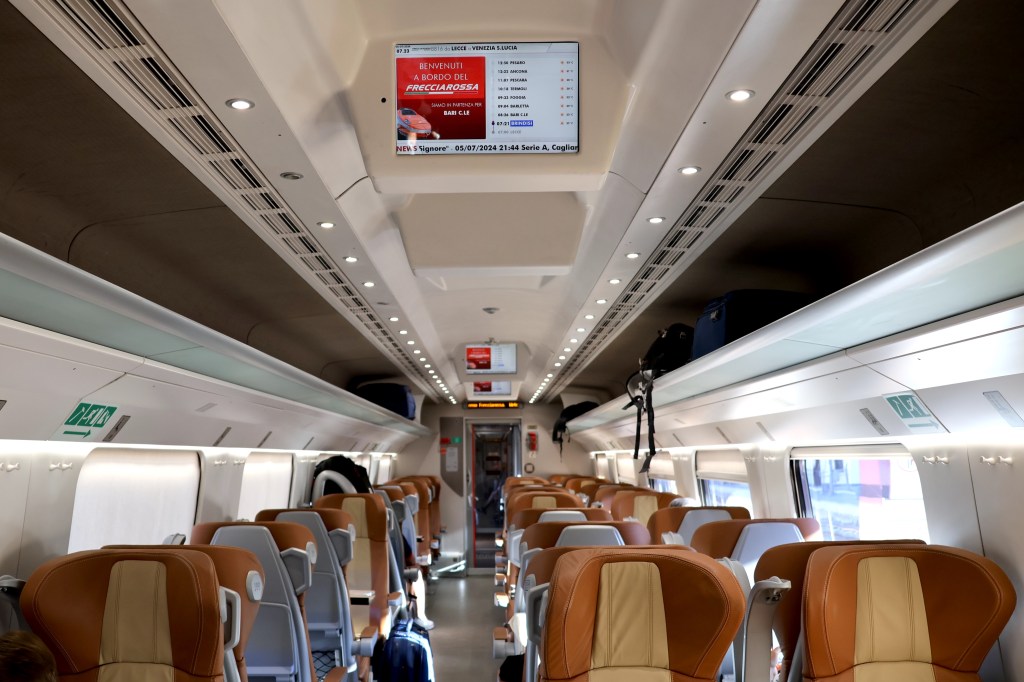
There are only two small luggage racks in our coach, so we stow our suitcases on the floor between back-to-back seats, where we can see them. These oversized albatrosses are never in anyone’s way and are always ‘attended’ for insurance purposes.
Seating
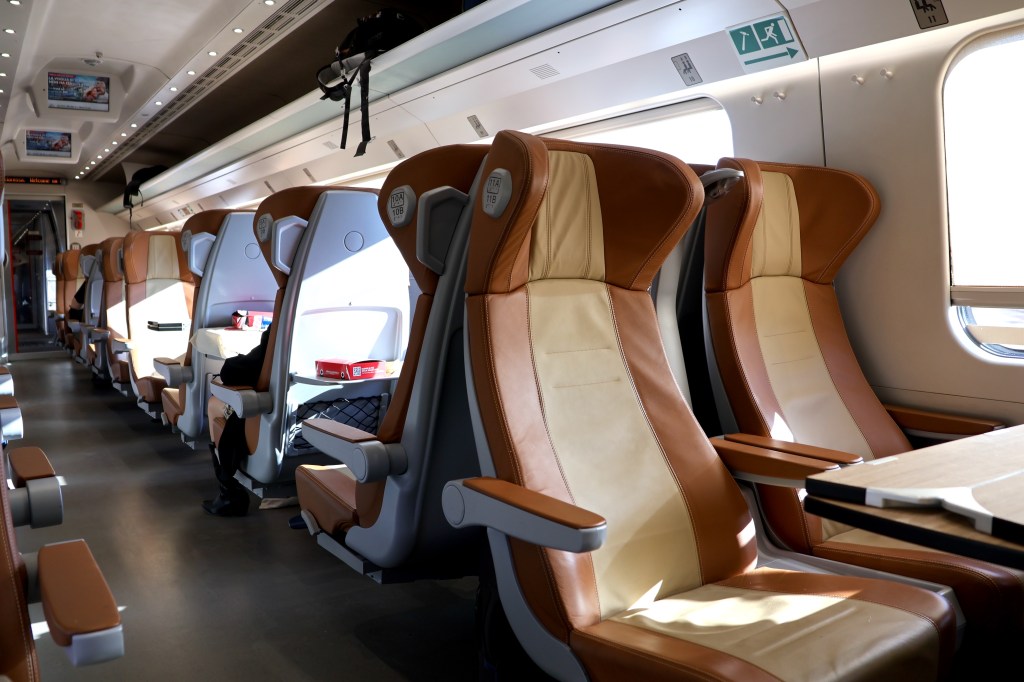
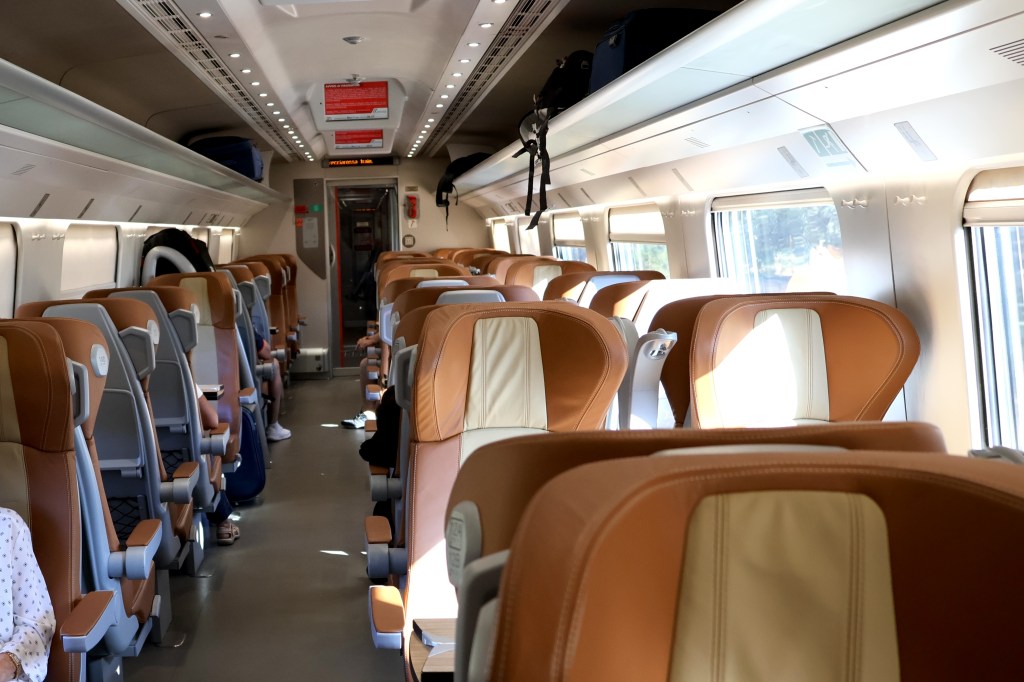
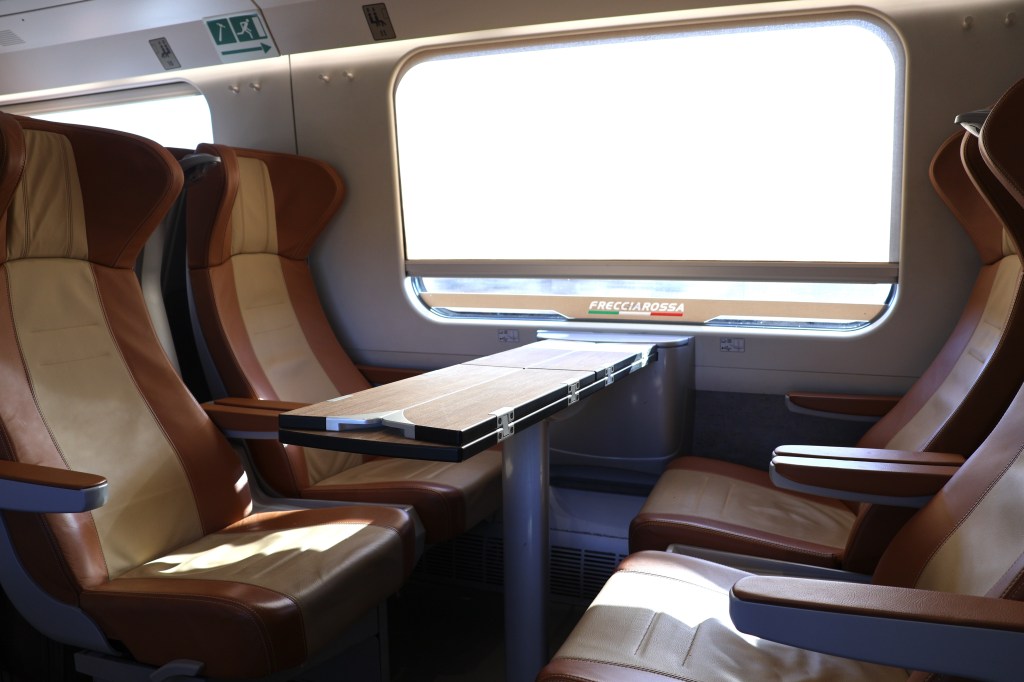
Arranged in a 1-2 configuration in business class, the comfortable reclining leather seats in cream and caramel (interesting colour choice) look as new as when the Frecciargento (Silver Arrow) trains were converted to Frecciarossa (Red Arrow) a year or two ago. Our single seats face each other, so one of us is travelling backwards, but we have an extendable table between us and more room than the paired forward-facing seats with seatback tray tables. The air conditioning feels just right.
We’re initially disappointed to be sitting on the left side of the train, not the Adriatic side. However, before we realise the water views will be mostly intermittent or obscured anyway (the beachside stretch between Ancona and Rimini is a notable exception), endless rows of olive trees and grapevines remind us of southern Italy’s greatest culinary attractions.
In the absence of the dramatic water views you’d expect of a route that traces the coastline, we turn our gaze inwards for the seat-hopping theatrics that are a reliable feature of train travel in Italy. Surprisingly, nothing much to see here either. The few passengers trying to unofficially upgrade their seats are calmly moved on by the friendly, attentive staff.
Food and drink
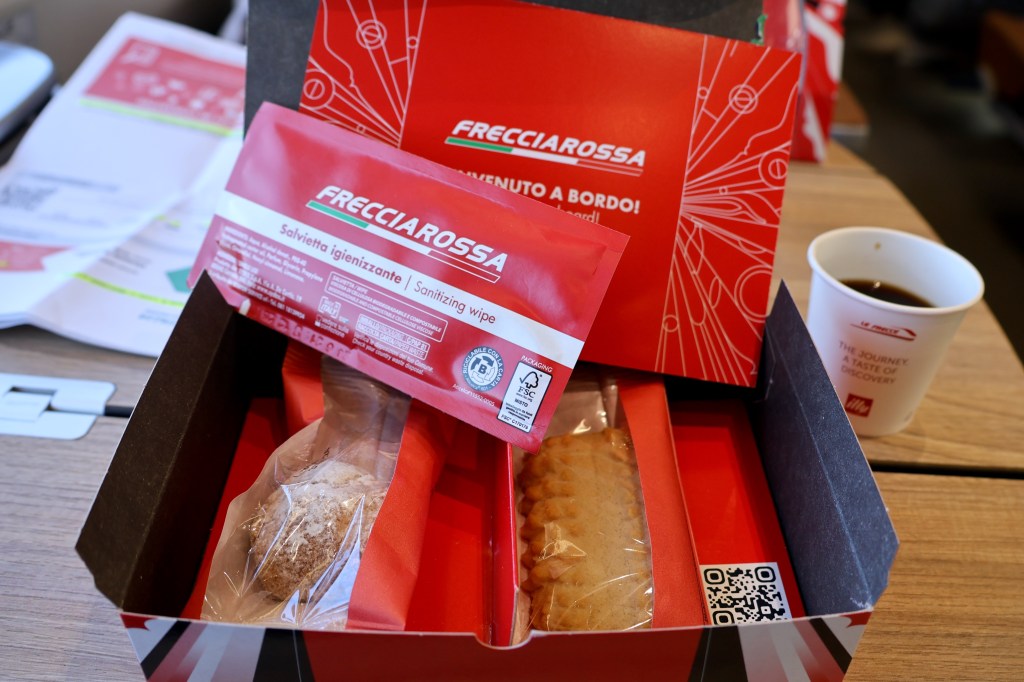
A catering attendant with a trolley welcomes us on board with an Australian-coffee-snob-approved espresso, a bottle of water and a snack box containing a shortbread and soft almond pastry. The QR code on the box launches a list of ingredients longer than a nonna’s scolding for eating out. The snacks certainly didn’t come out of her kitchen but are delicious nevertheless. There’s no further complimentary in-seat catering, however, we can purchase lunch items, such as pizza and panini, from the bistro car.
Entertainment and technology
Each seat is equipped with a power outlet and USB, so I keep my laptop and phone charged while using the FrecciaPlay entertainment, news and sports app I’ve downloaded over the train’s free wi-fi. English-speaking media is thin on the ground in Italy, so it’s a novelty to watch recent Hollywood films with English audio and Italian subtitles.
Speed
We average 150km/h (and sometimes get up to 180km/h) but this is no white-knuckle ride, as we don’t reach the Frecciarossa ETR 600’s operational maximum of 250km/h and we’re on a Pendolino (tilting train) that smoothly takes the curves. Our train arrives and departs each stop on time.
Perfect timing
We have no gripes about today’s service, so we’re bemused by the frequent PA announcements (in Italian and English) explaining how to lodge a complaint with Trenitalia… until we discover there’s a planned 24-hour train strike from 9pm. If you’re not keen to chance it, know that Italy’s railway sector is prohibited from striking between 27 July and 5 September.
Train of thought
Had we flown to Venice instead of taking the fast train, our trip would have produced four times more carbon emissions (yikes) and we might still be at the airport, schlepping our bags from the arrivals hall to the water taxi dock. But here we are, at our hotel in San Marco, toasting our arrival (and impeccable timing) with a Hugo Spritz and scheduling our next stop: spaghetti alle vongole with water views.
© Liani Solari
Posted 2 January 2025.
The writer travelled at her own expense.

 Liani Solari