

You don’t have to be an opera buff to enjoy Musica a Palazzo’s performances in an atmospheric palazzo on the Grand Canal.
Words and photography by Liani Solari
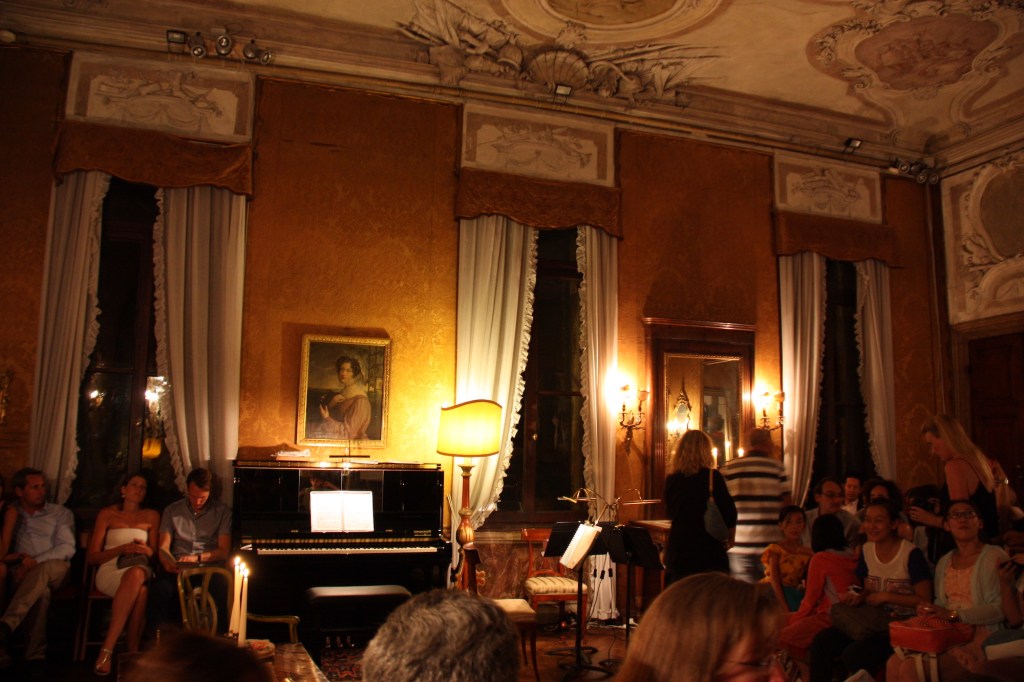
Despite the soft candlelight, I can still detect the cracks in the ceiling and stuccowork, the rough walls thinly disguised by deteriorating silk wallpaper, and the uneven terrazzo floor. The walls vibrate with every soaring operatic note as if defying the building’s foundations, which are little more than timber poles set into reclaimed swampland.
Attending a performance of Rossini’s comic opera The Barber of Seville in Palazzo Barbarigo-Minotto (pictured above) in Venice, I try to imagine the production in another setting – perhaps Venice’s ostentatious, dripping-with-gold La Fenice theatre – but I can’t. The fading grandeur and rustic elegance of this now uninhabited 15th-century palazzo lends a warmth to the performance that would be lost in a large, well-known venue. This is opera in the intimate mode.
We enter the palazzo via a dark, musty blind alley on a small canal, which belies the fact that the building backs onto the Grand Canal near the Santa Maria del Giglio ferry stop. Venice is like that. You can never fail to be surprised and fascinated by the grandeur and enormity of the interiors hidden behind the city’s less imposing facades and unassuming doorways, especially those of its churches. Venice really is the sum of its secret worlds.
Opera company Musica a Palazzo stages a number of operas in Palazzo Barbarigo-Minotto, the former home of the influential Barbarigo family, which died out in 1804 with the demise of the colourful and worldly dame Contarina Barbarigo. It’s an apt setting for an opera about a barber, as the barba (beard) in the Barbarigos’ family name is the stuff of legend. They assumed the name when a family member, Arrigo, defeated Saracen pirates in 880 CE and souvenired their beards, six of which are represented on the family’s coat of arms.
In this former palatial home, the audience, which numbers about 50, follows the singers and instrumentalists from room to room as the scenes unfold. We are individually greeted by a welcome host (who later doubles as the housemaid of cranky old Dr Bartolo) in the Central Hall before progressing to the Tiepolo Room (named for the 18th-century Venetian painter of the allegorical scene on the ceiling) and, finally, a bedroom with an alcove.
“Venice really is the sum of its secret worlds.”
Every aspect of the event flows effortlessly, including the prosecco at intermission, when we catch a glimpse of the Grand Canal at twilight through the palazzo’s Venetian Gothic windows.
Musica a Palazzo’s world-class opera singers have been perfectly cast in this dramma buffo (comic theatre) driven by the antics of the barber Figaro, an unashamed wheeler-dealer. “Quicker and quicker I go like greased lightning: make way for the factotum of the city!” sings the baritone, hinting at his upcoming ruse as go-between for the love-smitten Count Almaviva and Dr Bartolo’s ward, Rosina.
In this venue where the performers can really work the room, they capitalise on the intimate space to interact with the audience. Figaro plants himself in someone’s lap before planting a wig on a bald man’s head. Rosina, the object of affection in this comedic love triangle, flirts with the audience, feigning coquettishness with a glint in her eye.
The applause at the end is loud and appreciative, enough to lift the roof. As we file out of the palazzo, all abuzz, I wonder what the neighbours must think. We’ll probably never know. However, there’s a strong sense that we’ve just been initiated into their city’s secret life after dark.
© Liani Solari
‘Venice’s best-kept secret’ was originally published on Liani Solari’s Girls’ Own Adventure travel blog (now offline).

 Liani Solari