

Use Barcelona as your base to cross over to the “unsuspected and hallucinatory world of surrealism” in Figueres, Spain.
Words and photography by Liani Solari
Mae West was the queen of quips. This fact was not lost on Salvador Dalí when the Catalan artist devoted a room to the 1930s American actor in his Dalí Theatre-Museum in Figueres, north-eastern Spain. Keeping in mind that West believed it was “better to be looked over than overlooked”, visitors ascend a small flight of stairs to view the room through a reduction lens. Its contents instantly meld to become West’s face: a Botox-like frozen moment with a plastic fireplace nose and Saliva-Sofa overblown lips.

We had read in a guidebook that none of Dalí’s best-known works are in his home town of Figueres, a 140-kilometre bus trip from Barcelona. However, the guide had failed to acknowledge that the Dalí Theatre-Museum – Dalí’s greatest contrivance and his final resting place – is the largest surrealist work in the world, its scale matching the largesse of its creator’s ego.
Inaugurated in 1974, the museum occupies the site of Figueres’ former municipal theatre, which was razed in 1939 at the end of the Spanish Civil War. Dalí’s choice of site was purposeful. “The municipal theatre, or what was left of it, seemed to me to be very appropriate for three reasons,” he said. “First, because I am an eminently theatrical painter; second, because the theatre is in front of the church where I was baptised; and third, because it was precisely in the lobby of the theatre that I had my first exhibition of paintings.”
In this town of Dalinian beginnings and endings, which is easily navigable on foot, it’s a 10-minute stroll from Dalí’s museum to the house in which he was born in 1904 at No. 20 Carrer del Monturiol and his family’s subsequent home in nearby Placa de la Palmera. Neither of Dalí’s childhood homes is an architectural stand-out in the Catalan modernista streetscape, unlike his museum with its deep-pink walls studded with gold bread rolls; its lofty, precariously placed giant eggs; and its crowning glory, a huge glass geodesic dome.
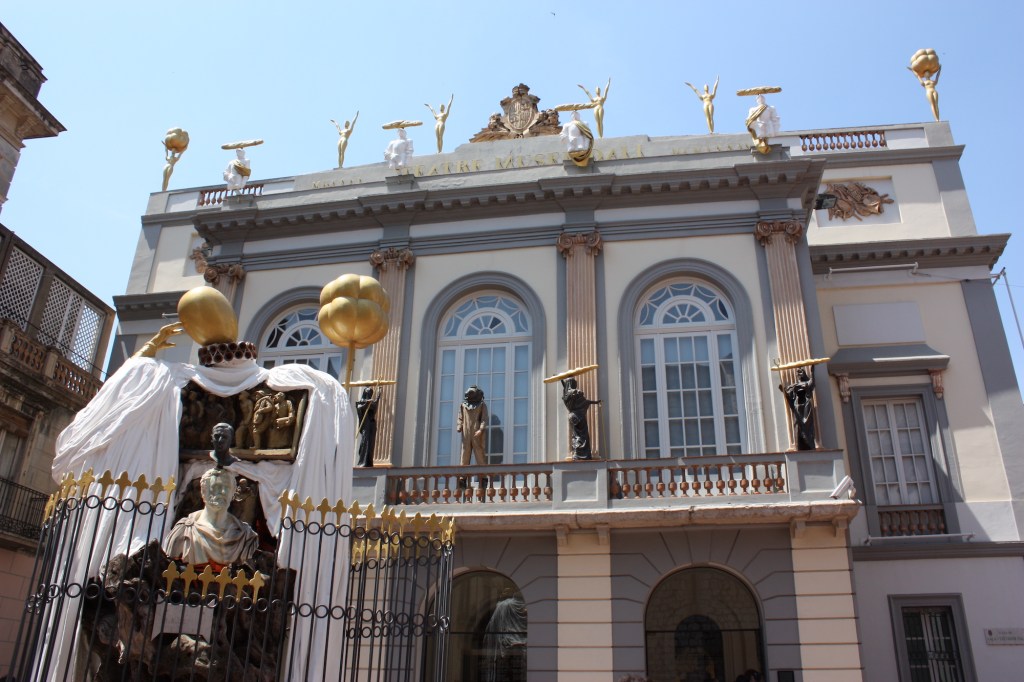
The whimsical entrance to the museum assures us that we are crossing over to another world – “the new, unsuspected and hallucinatory world of surrealism”, as Dalí described it – which is reinforced by the museum’s advice to consider Dalí’s idiosyncrasy by not following a preconceived route. Trying to ignore that flash of panic at the possibility of missing any part of the museum, I surrender to the ride.
There’s nothing fusty about this museum experience, I realise, as I jostle with other visitors to take in every detail of Dalí’s large Rainy Taxi (1974) sculpture in the light-filled internal courtyard that used to be the theatre stalls. Beyond the courtyard, sunlight streams through the glass dome to throw a natural spotlight on the stage area, illuminating the backdrop canvas that Dalí created for the ballet Labyrinth (1941). Even in death, Dalí is the ever-present director of these scenes, guiding visitors to appreciate the many ways he has played to the museum’s origins as a theatre.

On this self-guided tour, I’m curious to know on what grounds Dalí’s detractors had dismissed his works as the ravings of a chaotic mind. Certainly, the 1970 documentary Soft Self-Portrait of Salvador Dalí, narrated by Orson Welles, had highlighted the outlandish behaviour and outrageous beliefs of “The Divine Dalí”, as the artist styled himself. “Dalí is not crazy!” the artist ranted at the camera before staging several happenings at his home in nearby Port Lligat. These included Dalí leading a procession of a plaster rhinoceros’s head and two children dressed as cherubs along a coastal goat track, tossing handfuls of feathers into the air; and Dalí emerging with his wife, Gala, from a giant egg on the beach, like the offspring of Leda and Zeus.
Back in the museum that Dalí opened four years later, I start in the Treasure Room with The Spectre of Sex-Appeal (1932), which Dalí completed during his surrealist period before he was expelled from the movement in 1939. This paradoxically miniature painting of the young Dalí beholding an oversized, grotesque female apparition is rendered in fascinating detail with a sure hand. Dalí was no Sunday painter. Despite being unable to apply himself to his art studies in his youth, he could apply his hallucinatory visions to canvas with almost faultless classical precision. While the subject of the painting is disquieting, its rendering is measured, considered and anything but frenzied.
It’s also in the Treasure Room that I glean further insights into Dalí’s interior world. While Dalí arguably had his demons, there are few signs of them here in his portraits of his Russian wife and muse, Gala, with whom he instantly fell in love in 1929 while she was married to French poet Paul Eluard. Gala’s image, for the most part, is immune to the grotesquerie and dismemberment that afflict so many of Dalí’s other subjects, his brush instead meditating on her unaffected beauty in the serenely poised Galarina (1945) or elevating her to the supreme object of desire in Atomic Leda (1949). Theirs was not a conventional marriage, with Dalí installing Gala in her own medieval castle in nearby Pubol in 1969, visiting her only by written invitation.
In the museum’s Fishmongers’ Room, Dalí’s portrait of Spanish artist Pablo Picasso (the two met on a trip to Paris in 1926) shares the space with Dalí’s Soft Self-Portrait with Grilled Bacon (1941). The transparently unflattering Portrait of Pablo Picasso (1947) seems intent on resisting interpretation, the full title of the painting enigmatically nodding to the “genius” of Dalí’s fellow countryman. I’m amused and frustrated in equal measure, until I remember that Dalí claimed he could never understand his own works either. “Dalí only creates enigmas!” he said. (Sorry, Picasso, it’s not really about you.)
Like fellow Catalan artisan Antoni Gaudí, whose crypt is in La Sagrada Familia in Barcelona, Dalí is buried within his greatest work. I enter the museum’s dimly lit Crypt Room, forgetting the first lesson about Dalí: expect the unexpected. The air is sombre with orthodox reverence that almost seems to flout the memory of this flamboyant personality who made a career of thumbing his nose at convention and inflaming controversy. Dalí’s tombstone, too, is a surprisingly simple, unadorned slab inscribed with stoic roman capitals.
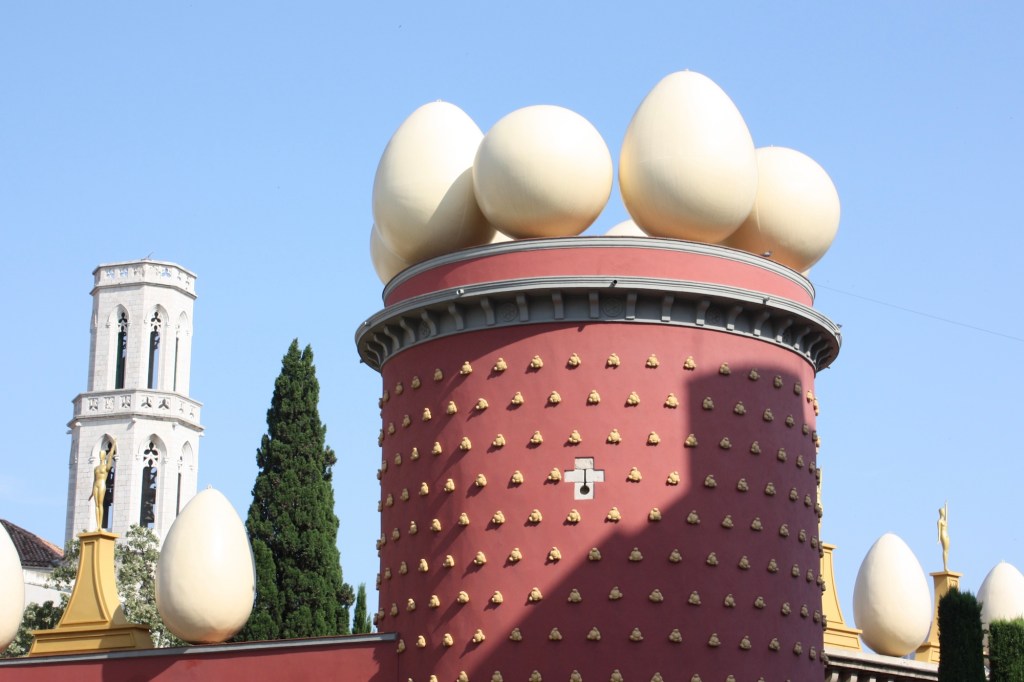
On leaving the museum, we wander around the building’s perimeter and happen to look up at just the right moment: the bell tower of Dalí’s baptismal church, Sant Pere, is seemingly sprouting up from behind the museum’s egg-crowned tower, Torre Galatea, where Dalí lived for five years before he died in 1989. No other scene could so poetically encapsulate the life of this theatrical illusionist. It’s in this unexpected moment that I appreciate what writer Josep Playa Maset referred to as Dalí’s “first and last acts of a perfectly planned scenario”. Or perhaps, to borrow a line from the character of Dalí in the film Midnight in Paris, “I see a rhinoceros!”
Getting there: Catalunya Bus Turistic operates return daytrips from Barcelona to Figueres (via Girona). You can also do a virtual visit of the Dalí Theatre-Museum.
© Liani Solari
‘Daytripping with Dalí’ was originally published on Liani Solari’s Girls’ Own Adventure travel blog (now offline).

 Liani Solari