
Words and photography by Liani Solari
‘Camperdown Cemetery: A walk among the tombstones’ was originally published on Liani Solari’s Girls’ Own Adventure travel blog (now offline) in 2014. Details about cemetery tours were correct at the time, but may have changed. To enquire about current tours, go to Newtown Erskineville Anglican Church.
In today’s market you’d be lucky to get change from $1 million for a terrace house in Sydney’s Inner West, but offloading land in Camperdown in the early decades of European settlement was a hard sell. Potential buyers didn’t want to live that far out from the colony!
In 1848, however, Mary Bligh, daughter of former governor William Bligh, managed to sell 12 acres to the 200 entrepreneurial businessmen who had formed the Sydney Church of England Cemetery Company. There they established Camperdown Cemetery, the colony’s third burial ground, in the suburb now known as Newtown.
Today, wading through knee-high kangaroo grass – a protected species among the decaying sandstone grave markers – you have to close your eyes to imagine what the Cemetery Company envisioned in 1848: a manicured English-style cemetery to put Sydney’s two unkempt government-run cemeteries to shame.
On most Sundays, while parishioners are pulling up a pew in St Stephen’s (the onsite church designed by architect Edmund Blacket), other locals are unpacking their picnic baskets on stone slabs in the cemetery.
Once a month, Marcelle Rodgers, the wife of St Stephen’s former rector, and archaeologist Jenna Weston conduct a two-hour walking tour of Sydney’s oldest existing European cemetery (now four acres), introducing participants to Napoleon’s harpist, a verified ghost, the victims of Australia’s Titanic story, the real Miss Havisham and many others…
Napoleon’s harpist
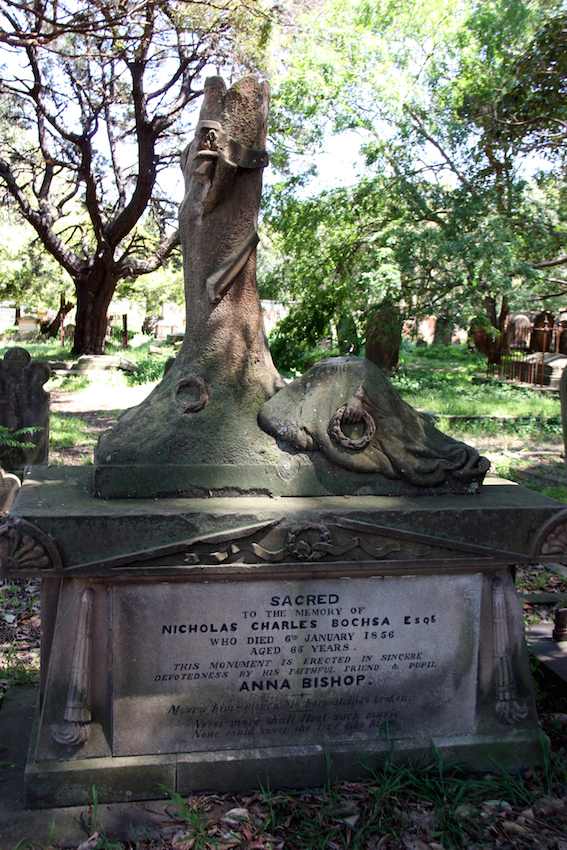
In 1856, opera singer Anna Bishop erected what can only be described as a Victorian death monument – with all the histrionics that implies – to her lover, Nicholas Bochsa. Nicholas had been the imperial harpist to Emperor Napoleon of France and had given lessons to Empress Josephine, fuelling a passion for harp-playing among Parisian ladies.
In 1817, to avoid 12 years’ imprisonment for forgery, Nicholas fled to England, where he was a big hit in London. There he met composer Sir Henry Bishop and his young opera singer wife, Anna. Nicholas and Anna ran off together, touring Europe and America before taking their highly anticipated act to Australia. However, they gave just one concert in the colony before Nicholas died.
Crowned with Anna’s self-portrait (rendered headless by vandals), Nicholas’ tombstone in Camperdown Cemetery declares her “sincere devotedness” as his “faithful friend and pupil”. But, judging from the extravagance of the piece, local stonemason John Roote Andrews had read between the lines.
Mr Eternity’s serendipity
The headstone of Lieutenant John Putland – Governor Bligh’s aide-de-camp and Mary Bligh’s first husband – was ‘homeless’ for a time, not unlike the man who inadvertently led to its discovery in Marcelle Rodgers’ garage when she lived next door to Camperdown Cemetery.
The find was made about 10 years ago when a film crew was working in the cemetery on a documentary about Arthur Stace, dubbed ‘Mr Eternity’. Arthur, who led an itinerant lifestyle and suffered from alcoholism, was inspired by a preacher at the Burton Street Tabernacle in Darlinghurst to chalk the word ‘Eternity’ in perfect copperplate on the streets of Sydney from 1932 until his death in 1967.
The film crew wanted to chalk the word ‘Eternity’ on the back of a headstone. Rather than disturb anything in the cemetery, Marcelle agreed to bring out a headstone that was stored in her garage, without taking notice of the inscription to Putland. “The next week, people started knocking on my door, saying, ‘You won’t believe what’s turned up in the cemetery – an important historical piece!’” she recalls.
Putland’s headstone predates Camperdown Cemetery by 40 years, and no-one quite knows how it got there. Historians suspect that, like Mr Eternity, it had done the rounds in Sydney.
Thomas Downes and the “sham balloon ascent”
Take a closer look at the headstone of 11-year-old Thomas Downes and you’ll realise the hot air balloon isn’t a reference to a child’s toy.
In 1856, a Frenchman, Monsieur Pierre Maigre, sold tickets to hundreds of people to watch him launch the first flight in Australia in the Domain, Sydney. It all went disastrously wrong when the balloon caught fire and didn’t rise. Accusing Maigre of ripping them off, the crowd began to riot. In the chaos that ensued, a pole anchoring the hot air balloon was knocked down, striking the Downes boy in the head. While Maigre fled, the boy was taken to the Sydney Infirmary and Dispensary, where he died from his head injuries.
Thomas’ death went before the courts, the jury concluding, “We unanimously consider that, if any person is to blame, it is Monsieur Maigre, the perpetrator of the sham balloon ascent.”
Dr Charles Nathan, the surgeon who attended to the boy at the Sydney Infirmary and Dispensary, is also buried in Camperdown Cemetery. In June 1847, he administered the first anaesthetic in Australia, which was understandably a big deal. Until then, the few operations that were possible were carried out with no pain relief; after a dose of opium and/or alcohol; or after a good old-fashioned blow to the patient’s head that would ‘knock them out’. (These days we’d call that malpractice.)
Convict ghost
Camperdown Cemetery reportedly has several ghosts, but only one that can be verified: Bathsheba Ghost. In 1838, Ghost was convicted at London’s Old Bailey court of receiving stolen property. Sentenced to 14 years in the colony of New South Wales, she was forced to leave her husband and three-year-old son.
Thirteen years into her sentence, Ghost was appointed to one of the most prominent and well-paid positions available to a woman in the colony: matron of the Sydney Infirmary and Dispensary. Along with Dr Charles Nathan, she attended to the boy fatally injured in the hot air balloon accident.
Ghost remained in Sydney and never remarried. It is not known what happened to her husband, however, towards the end of her life, her son immigrated to Australia and she came to know her grand-daughter.
Australia’s own Titanic
Towards the far corner of Camperdown Cemetery is a mass grave for the victims of the Dunbar shipwreck. Some refer to the Dunbar tragedy as ‘Australia’s Titanic story’, but given that it occurred in 1857 (the Titanic sank in 1912), perhaps the Titanic should be ‘Ireland’s Dunbar story’?
Unlike the ships of the First and Second Fleets crammed with convicts, the Dunbar was an English sailing ship bringing upper-class passengers and their servants back to Australia. On its second voyage to the colony, disaster struck.
At about midnight on 20 August 1857, during an east coast low, Captain Green made a fatal error: he thought he was guiding the ship into Sydney Harbour, but he was a kilometre off course. A massive wave smashed the ship against the wall of the Gap at Watsons Bay, and within a couple of waves the ship was destroyed.
All but one of the 122 people on board perished. Miraculously, crewman James Johnson was washed up on a ledge at the Gap, where he spent two days before he was seen and rescued. James later became a lighthouse keeper up the coast at Nobbys Beach, Newcastle – where, the story goes, he saved the sole survivor of a shipwreck, like himself.
While you won’t find the Dunbar’s sole survivor in this cemetery, you will find another love triangle and a ghost story. Next to the Dunbar mass grave is that of Captain John Steane, also a victim of the Dunbar. His body was among the handful recovered intact, so he was given an individual burial. Just a couple of metres away, within eyeshot, is the grave of John’s alleged lover, Hannah Watson, and her husband, Captain Thomas Watson, the Harbour Master of Port Jackson.
According to the story, when Thomas discovered his wife’s infidelity, he cursed the lovers. Hannah wrote to John, begging him not to return to Sydney, but it was too late – he had already set sail on the Dunbar. While the ill-fated lovers were never reunited in life, Hannah’s ghost has reportedly been seen drifting from the tomb she shares with her husband to the grave of her lover.
The real Miss Havisham?
When her well-to-do father, James Donnithorne, died in 1852, Eliza Donnithorne inherited most of his estate, including their home, Cambridge Hall (no longer extant), at 36 King Street, Newtown.
Four years later, Eliza was to marry shipping clerk George Cuthbertson. However, on the morning of the wedding when all was ready – the bride decked out in her gown, the wedding breakfast laid out, and the guests assembled – George failed to turn up.
From that time on, the jilted bride never left the house, opening the door only to a select few and taking refuge in books. The wedding breakfast remained on the dining table, gradually decaying. Eliza died in the house 30 years later, aged 60, and was buried in Camperdown Cemetery with her father, James.
Sound familiar? Eliza Donnithorne bears an uncanny resemblance to the eccentric recluse Miss Havisham in Charles Dickens’ novel Great Expectations. Though no-one can be sure if Eliza was the real-life inspiration for Miss Havisham, the Dickens Society in England gave Eliza the benefit of the doubt and money towards the restoration of her granite headstone when it was knocked over and broken in 2004.

Dickens published Great Expectations four years after Eliza was jilted. You have to wonder if she read his novel while she was holed up in Cambridge Hall. If so, did she recognise shades of herself in Miss Havisham? Today, ironically, the slab next to the gravestone of reclusive Eliza is a popular picnic table.
© Liani Solari

 Liani Solari