
Interview by Liani Solari
Published on mindfood.com, August 2009.
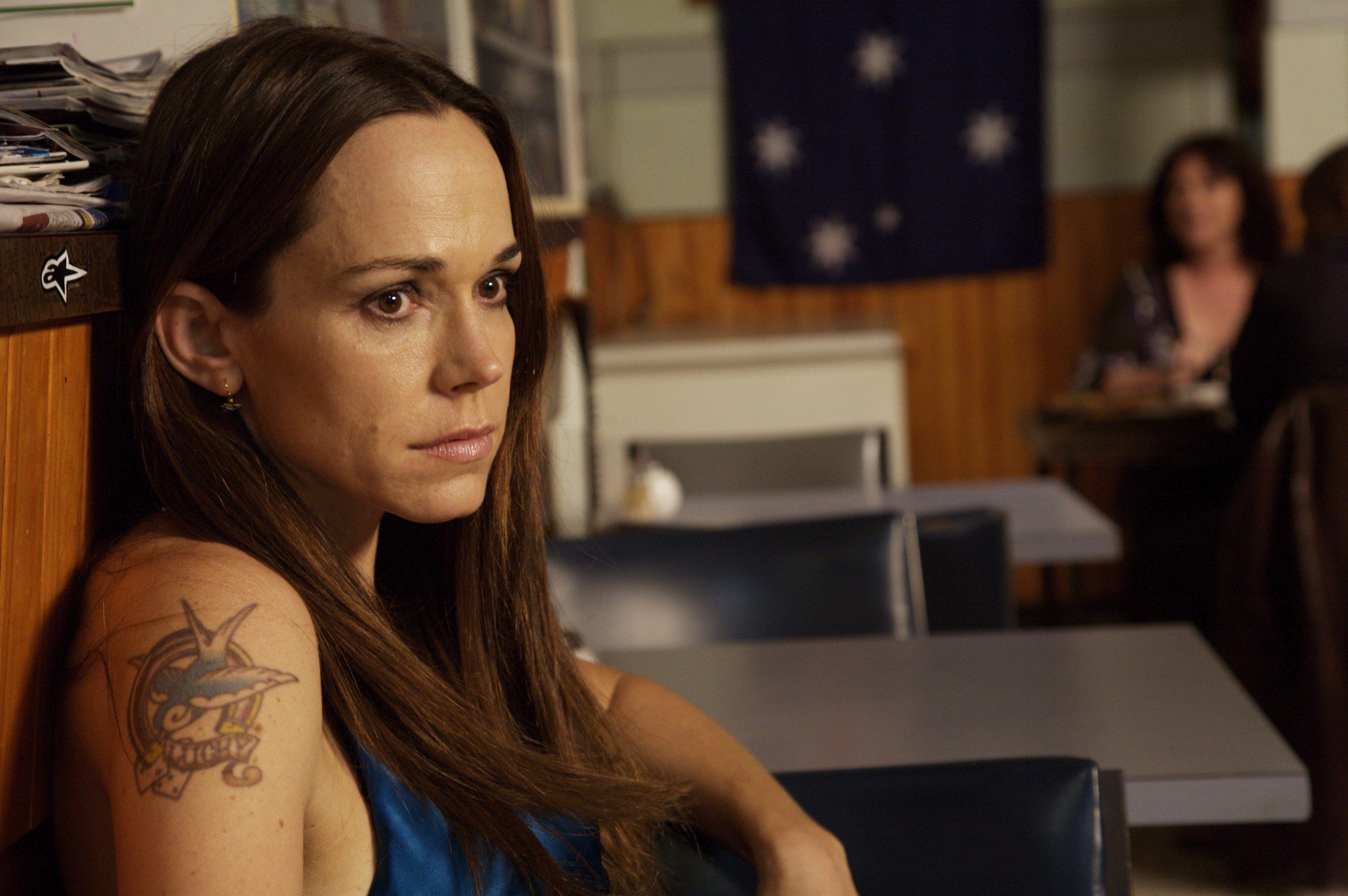
Image: Frances O’Connor playing Rhonda in the film Blessed (Head Gear Films / Album / Alamy Stock Photo). Blessed was released in Australian cinemas on 10 September 2009.
In director Ana Kokkinos’s latest film, Blessed, seven troubled children wander the streets for a day and a night in an attempt to find their way home. When dawn breaks, the audience experiences their journeys from the perspectives of their mothers. Australian actor Frances O’Connor plays Rhonda, a mother who has negligible parenting skills but genuinely loves her children, insisting they are her “blessings”.
On the eve of the release of Blessed, Frances O’Connor speaks with Liani Solari about onscreen and real-life motherhood and her passion for acting.
LS: As a mother [O’Connor has a son, Luka, 4], how did you get into the headspace of playing a character who has negligible parenting skills?
FO: When you’re representing any character, you start with what you can understand about them. Playing Rhonda involved understanding her history to explain why she is the way she is. I don’t think she was mothered particularly well herself. She is stuck in a vicious circle that continues from generation to generation. Even though Rhonda is not a very good mother, she does love her children, which was something I could hang onto when I was playing her.
What else did you draw upon to portray Rhonda with empathy?
If you’re playing a character that has some issues, you can’t really judge that character, because no-one would want to watch a character like that. You have to find something in the character that you understand. Everybody starts out as a child, as basically a good person, so the question is: how did Rhonda get to where she is? I don’t see her as a bad person. I see her more as a victim of what happened to her as a child, which has been perpetuated in her [adult] life. I kind of feel sorry for her.
There is a scene in Blessed in which your character finds herself in a situation that is inconceivable for a parent. How did you prepare yourself for that scene?
It was really hard to know how to get in there. It’s the kind of situation that every mother dreads. Every mother has, at some point, thought, “Oh my God, if that ever happened, it would just kill me.” So I drew upon that instinct.
Your role in Blessed is remarkably different from other roles you’ve played in film and television…
That makes it kind of fun. I like to do that in my professional life, to play roles that are different, to be in different cultures, to play different situations. It makes it more interesting for me.
How do you measure your success as an actor?
Like anything, there are always moments when you think, “Oh, I wish I’d done that differently,” but I’ve really enjoyed all the roles I’ve played. Now that I’m a mother, my priorities have changed slightly in terms of how I view my work. I think that’s quite healthy; it’s a healthy progression. When you’re a mother and you get back to work and start focusing on it again, you’re less precious about it. I think it relaxes your work, and your work actually expands rather than shrinks.
How do you cope with fame?
With the kind of level that I’m at, it’s doable. In America [O’Connor lives in Los Angeles], if I’m in a shop, for instance, people will come up to me and say, “Oh, I like your work,” but it’s not invasive. Luka wouldn’t even be aware of it. I’m quite a private person anyway. I’ve never really courted [fame], I’ve just enjoyed the acting side of it, so it’s a good balance.
Was there ever any question about becoming an actor?
I like writing as well, but I really am an actor. Probably since I was five, it’s what I wanted to do. I always loved using my imagination and pretending. That’s really what an actor does, I guess.
It’s great to be able to earn a living doing something you love…
It’s been a good ride so far; I can’t complain. Thank God I found out that acting was my thing to do. I remember the first time I got a job as an actor, I thought, “Oh my God, I actually get paid for this!”
For you to say yes to a script, what criteria does it need to meet?
Sometimes a script isn’t perfect but the people attached to it are really interesting, and you think, “Well, there’s enough potential in this script and the people around it are really good, so it’s worth jumping in there.” Or sometimes a script is brilliant but one of the other elements is not so good. If the script is not so good, I don’t think there’s any point in doing it, because it’s really hard, almost impossible, to fix a script on the job. The script has to be good.
What attracted you to the Blessed script?
I’ve always loved Ana Kokkinos as a director and I’ve loved her films. And I think Andrew Bovell is a really talented writer. The script was just perfect from the first sentence to the last. It was just the most beautiful script and the characters were so beautifully written. I really liked the character [Rhonda] because there were so many complexities to play. I thought it would be a real challenge, which is what you’re looking for as an actor, and I felt up for a challenge.
When I was doing [television series] Cashmere Mafia, that was the perfect job while Luka was a two-year-old; I just wanted to work on something that was fun and light. I think it’s very hard to split yourself. They [young children] need so much of you. I hadn’t really felt like getting back in there until about a year ago. Before that, I wasn’t really in the right headspace to do something heavy.
What was the best thing about working with Ana Kokkinos?
She was very passionate about the project and she was really detailed about it. The thing that helps you focus as an actor is when someone has their eye on you in terms of really watching what you’re doing and drawing it out of you. It ultimately paid off, and I think everyone really enjoyed working like that.
Blessed was filmed in Melbourne. How did it feel to be back in Australia [O’Connor was raised in Perth] co-starring with Aussie actors Miranda Otto, Deborra-Lee Furness and Tasma Walton?
Well, we never actually got to hang out at all because Ana made four separate films [in one]. I left and then Miranda arrived. So I never really got to see anybody. This week we finally got together, which was nice. Working in Melbourne was great because it feels very familiar, and working with an Australian crew was so comfortable.
What are the most striking differences between your upbringing in Perth and your son’s upbringing in Los Angeles?
He’s learning baseball, which is hilarious! But the thing about California is the people are very laid-back in a way that is similar to Australia, which is really nice.
What is your greatest challenge as a working mum?
Just trying to be present, because usually when you’re at work you’re thinking about your kid, and when you’re with your kid you’re thinking about your work. It’s really hard to just be present where you are. As a mother, you split yourself in a lot of different directions.
You and your partner, Gerald Lepkowski, have been together for 15 years. What is the key to a good relationship?
Low expectations [laughs]. No, not really. Seriously, I think the key is not being too hard on your partner and not expecting too much from them, and just accepting them for who they are. It’s your main friendship, really, so it’s about being good to the other person. I really do think that is the key. We’re human beings, so we don’t expect to be perfect.
What is the greatest thing that being a parent has taught you?
It helps you to be in the moment a lot more. When you’re single, you’re always thinking about what’s coming up, but with a kid you’re forced to slow down and just be with them. I really enjoy doing that and discovering things again as they do. You laugh a lot more when you have a kid.

 Liani Solari