

The ancient dramas on Delos – the isle of Apollo, god of the sun – would put today’s island reality shows in the shade.
Words and photography by Liani Solari
Adapted from the feature published in WellBeing magazine’s Escape Guide, November 2005
Featured image: “Delos (XII)” by ISAWNYU is licensed under CC BY 2.0
Zeus, lord of the Olympian gods and a notorious predator, had again incurred the wrath of his goddess-wife Hera with his extramarital exploits. Wreaking vengeance on her latest hapless rival, Hera prohibited the titaness Leto, who was pregnant to Zeus, from settling anywhere in the world.
Forced to wander the earth in search of a secure place to give birth, Leto eventually found refuge on the island of Delos – itself a wanderer beneath the Aegean Sea until the god Poseidon called it forth from the deep and Zeus fastened it to the seabed with chains (which, according to popular belief, rendered the island immune to the area’s frequent earthquakes). Leaning against a palm tree and enduring a difficult labour of nine days and nights, Leto gave birth to her divine twins: Apollo, god of the sun, archery, music, poetry, oracles and healing; and Artemis, the virgin huntress and goddess of the moon.
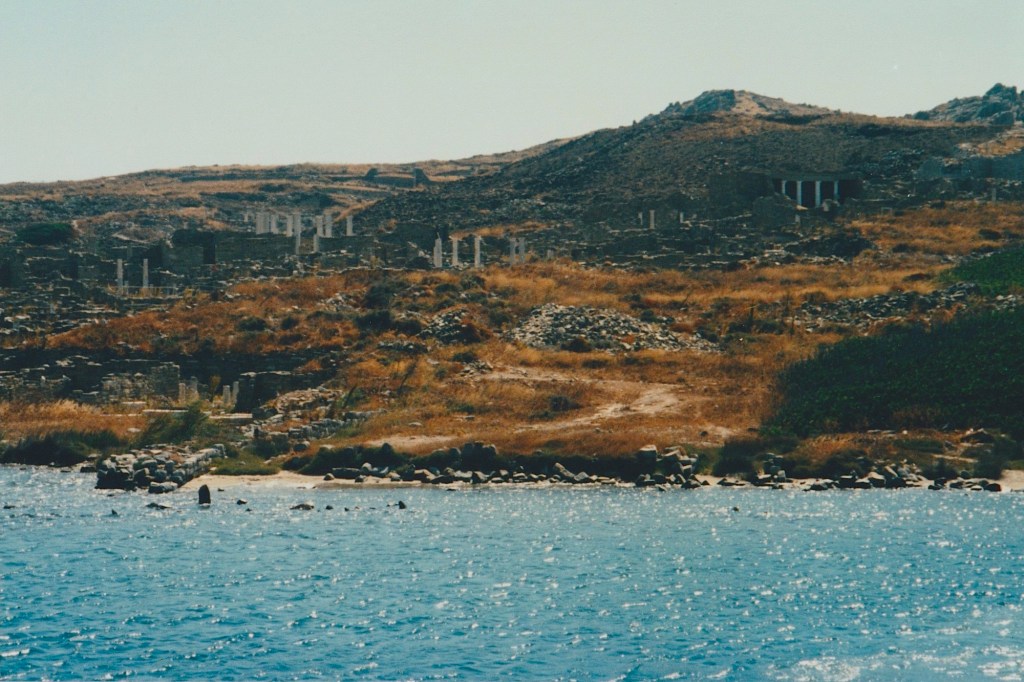
Having granted Leto asylum, this island of meagre size and means – a barren and almost waterless 3km2 rock of gneiss and granite in the centre of the Cyclades archipelago – would become the most sacred of the Cycladic islands, the political centre of the Aegean and a flourishing cosmopolitan port. In 1990, UNESCO inscribed Delos, now uninhabited but for a handful of archaeologists, on the World Heritage List for its great cultural and historical value.
Leap of faith
The island derives its name from the Greek word delos, meaning to manifest, make clear, evident or plain – a reference to Delos being raised from the deep by Poseidon. It seems apt that the Greek language has also given us the word psychedelic (from psyche, meaning mind, and deloun, from delos) to describe hallucinogenic states, as the prevalence of age-old herculean feats of engineering in Greece can make you wonder if you’ve lost your marbles.
Given the indistinct perception of time that living side by side with the ancients must encourage, it isn’t difficult to fathom why parts of Greece, particularly the islands, tend to operate on ‘ish’ time. And, of course, for any custodian of archaeological evidence of global interest, there’s always that fine balance between forging ahead and preserving antiquity. Nothing, however, ever gets in the way of a good story about the gods behaving badly.
Today, for the residents of a country where you could stub your toe on a temple ruin on your way to work, there’s little doubt Greece’s glorious heroes and the gods on Mount Olympus existed. Visit the temple of Poseidon at Cape Sounio, near Athens, and your guide will take you to the “exact spot” on the precipice where Aegeus, erroneously believing his heroic son Theseus had fallen victim to the beastly Minotaur of Crete, leapt into the sea, thus giving the Aegean its name. Despite 90 per cent of the population being Greek Orthodox Christian, modern-day Greece relishes its rich legacy of pre-Christian narratives, which continue to inform its mindset and captivate its visitors.
The rise of Delos’s son
“I think you [Delos] will never be rich in oxen and sheep, nor bear vintage nor yet produce plants abundantly. But if you have the temple of far-shooting Apollo, all men will bring you hecatombs [sacrifices] and gather here … and you will feed those who dwell in you from the hand of strangers; for truly your own soil is not rich,” prophesised Leto in the Homeric Hymn to Delian Apollo, dated to the 8th century BCE.
Incredibly, this tiny island that lacked inherent resources to support its inhabitants began to emerge as the pre-eminent seat of Apollo’s worship in the same century, attracting pilgrims and patrons from all over the Aegean. Today, almost the entire island is covered in the relics of Delos’s glory days, luring modern-day pilgrims from around the world to this archaeological site comprising three temples to Apollo, abundant temples and monuments to foreign and other Greek deities (including Hera), agoras, treasuries, altars, opulent houses with fine mosaic floors, a hippodrome, stadium and gymnasium, and a theatre that could hold up to 5500 spectators.
While settlement on Delos can be traced back to the Early Bronze Age, the island was later colonised by Ionians (Greeks spread throughout the Cyclades, Asia Minor, Attica and Euboea) who, in the 8th century BCE, began to celebrate the birth of Apollo on Delos with an annual festival of games, singing and dancing. The festival was attended by all Ionians, such was the importance of the island as the principal cult centre of the Aegean.
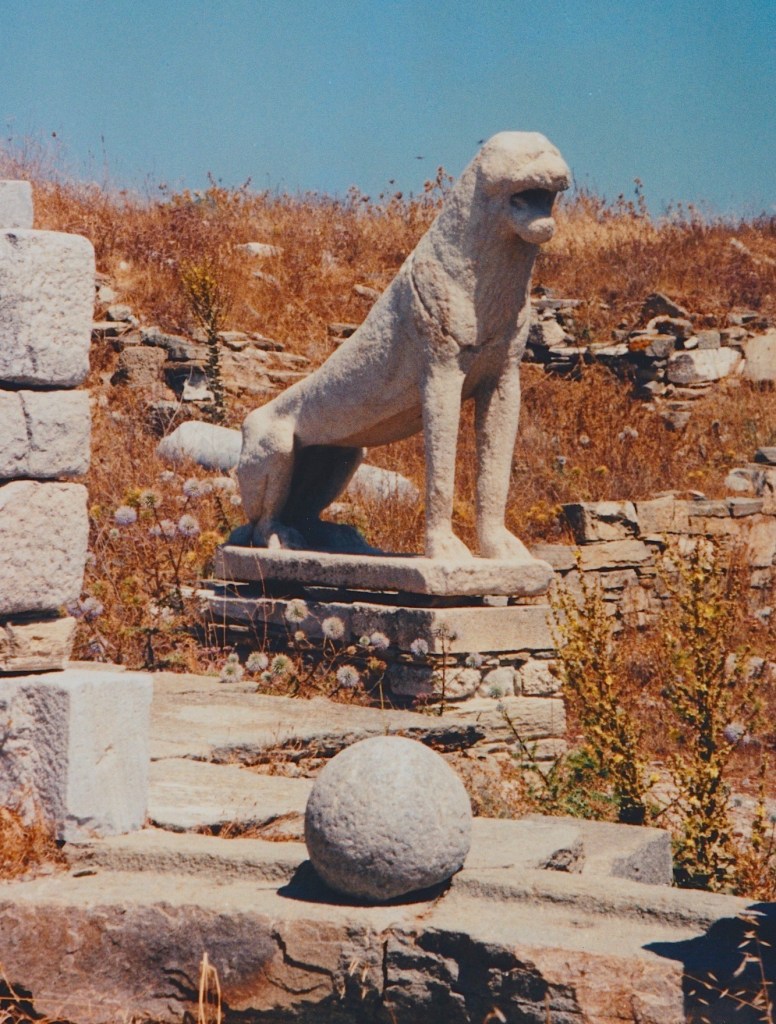
In the 7th century BCE, the nearby islands of Naxos and Paros – sources of superior marble – were Delos’s most notable patrons. The Naxians, who were thought to control the island at the time, dedicated to Apollo a colossal statue of the god and an estimated nine to 16 marble lions, which flanked the sanctuary’s original approach, the Terrace of the Lions.
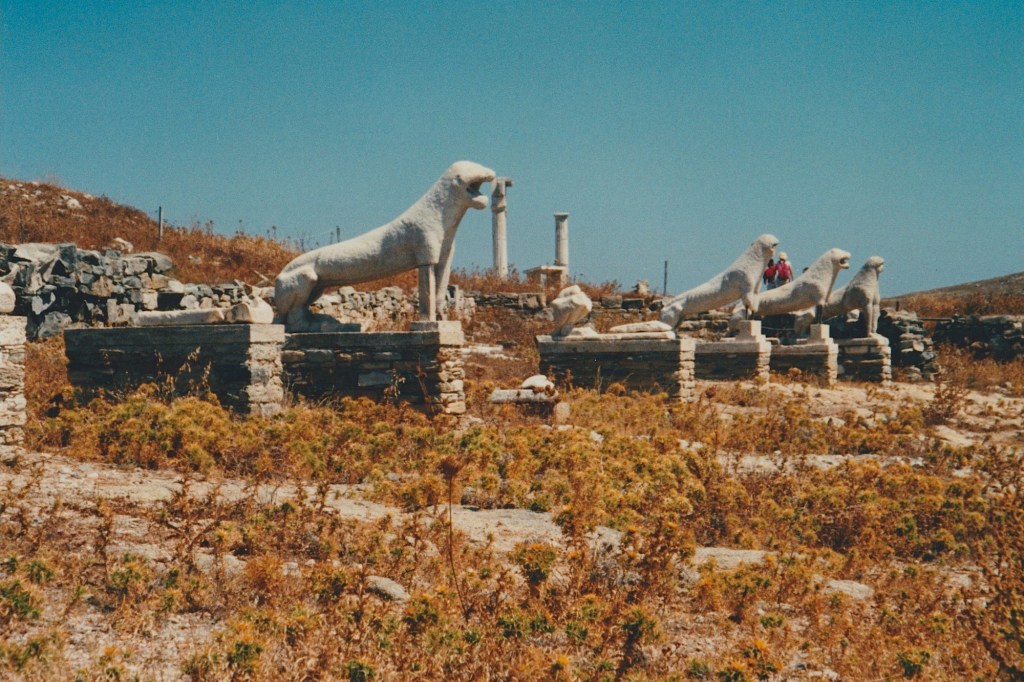
These leonine guardians of the sanctuary – now weathered ‘sightless’ and numbering only five – were magnificent in carrying out their charge, silently roaring across the island’s Sacred Lake. In 1999, the original statues were replaced with replicas and moved to the onsite archaeological museum to protect them from being further ravaged by the sea air and strong winds. In 1925, the Sacred Lake was filled in because of the danger of malaria, and a palm tree planted in the centre in reference to Apollo and Artemis’s birth.

‘Purifying’ the island
Fleeing Delos during Persia’s attack on Greece in 490 BCE, the Delians left Apollo’s sanctuary (and the riches it had amassed as a major cult centre) defenceless except for its reputation. Amazingly, Delos’s fame proved to be all the fortification it needed to remain inviolate, for the Persian commander Datis, hearing the island was the birthplace of two pre-eminent deities (the sun and the moon), would not allow the ships of his invasion force to touch its sacred shores.
In 478 BCE, Apollo’s sacred isle boasted another momentous birth – that of the Delian League, the precursor to the Athenian Empire. Led by Athens, this maritime alliance of the Greek city-states against Persia had its headquarters on Delos, where regular meetings of the allies were held and the treasury of the alliance was initially located.
With Athens the dominant force, Delos was temporarily troubled by xenophobia when the Athenians banished the Delians from the island in 422 BCE on a charge of impurity. (Unlike today’s understanding of the term xenophobia – from the Greek xenoi, meaning foreigners or aliens – the word xenoi specifically referred to non-Athenians.) Thanks to Apollo, the Delians were recalled when Athens attributed its subsequent misfortunes in the Peloponnesian War to having angered the god by banishing his devotees from the island.
You have to wonder if the island’s inhabitants were also troubled by thalassophobia, thanatophobia and tocophobia – fear of the sea, dying and childbirth, respectively. In 426 BCE, Athens ‘purified’ Delos by clearing all the burials on the island and depositing the remains in a ‘purification pit’ on the nearby island of Rheneia. Deaths and births were consequently prohibited on Delos (ironic, considering Delos was the only place in the world to offer pregnant Leto refuge), so the dying and women about to give birth were taken to Rheneia. Today, sailing across the notoriously choppy channel between Delos and Rheneia, I can only begin to imagine their trauma.
“But all, except their sun, is set”
Ideally located on the trade routes from Greece and Italy to the East, Delos enjoyed a time of immense growth as a prosperous cosmopolitan trading centre before its decline in the 1st century BCE. Declared a free port in 167 BCE, the island attracted merchants, bankers and mariners from other Mediterranean lands, including Egypt and Syria. They made Delos their home, and Apollo shared his sanctuary with their foreign deities. During this period, the isle of the sun revealed a shadow side, too, as the principal market for the slave trade. Up to 10,000 slaves were traded per day, according to Greek historian Strabo (1st century BCE).
Finally destroyed and plundered by pirates in 69 BCE, Delos was unable to regain its former splendour. In 1873, the French School at Athens began unearthing the glory that was Delos, and continues to do so today. Earlier that century, English Romantic poet Lord Byron (1788–1824), renowned as much for his extravagant lifestyle and many love affairs as his work, had immortalised Delos in The Isles of Greece:
The isles of Greece! the isles of Greece!
Where burning Sappho loved and sung,
Where grew the arts of war and peace,
Where Delos rose and Phoebus [Apollo] sprung!
Eternal summer gilds them yet,
But all, except their sun, is set.
Possessing Apollo’s gift of poetry and a fancy for emulating the gods in being “mad, bad, and dangerous to know”, Byron had an affinity with Greece’s sun-drenched isles that might not seem particularly remarkable. What is remarkable, though, is just how prophetic Byron’s words would prove to be, as light continues to be shed on the golden days of Apollo’s sacred isle with every passing century.
Delos is a 30-minute boat trip from the island of Mykonos. Guided tours are available, however, there is no accommodation on Delos.
Photographs (except featured image) © Liani Solari

 Liani Solari